Back

Allylic Halogenation quiz

Control buttons has been changed to "navigation" mode.
1/15
  • What is the main difference between traditional halogenation and allylic halogenation?

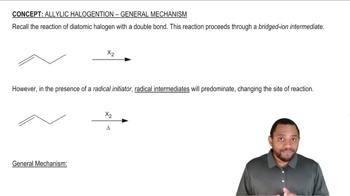
    Traditional halogenation adds halogens across a double bond, while allylic halogenation replaces an allylic hydrogen with a halogen using radical initiators.
  • What are three common radical initiators used in allylic halogenation?

    Heat, UV light, and peroxides (such as H2O2 or ROOR) are common radical initiators.
  • What is the allylic position in an alkene?

    The allylic position is the carbon atom adjacent to a double-bonded carbon in an alkene.
  • Describe the initiation step in the mechanism of allylic halogenation.

    The diatomic halogen undergoes homolytic cleavage, forming two halogen radicals due to the action of a radical initiator.
  • What happens during the propagation step of allylic halogenation?

    A halogen radical abstracts an allylic hydrogen, forming an allylic radical, which then reacts with another halogen molecule to regenerate the halogen radical.
  • Why does allylic halogenation often produce a mixture of products?

    The allylic radical formed can resonate, allowing the halogen to add at multiple positions, resulting in a mixture of products.
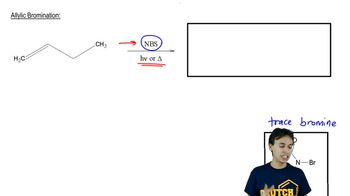
  • What is the role of N-bromosuccinimide (NBS) in allylic bromination?

    NBS provides a controlled, low concentration of bromine radicals, minimizing unwanted addition products and favoring allylic substitution.
  • Why is Br2 not preferred for allylic bromination?

    Br2 leads to excessive addition across the double bond, producing unwanted dihalide products instead of selective allylic bromination.
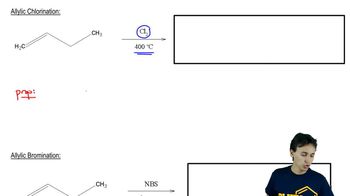
  • At what temperature is allylic chlorination typically performed for good yield?

    Allylic chlorination is typically performed at 400 degrees Celsius.
  • What must you always draw in the propagation step of allylic halogenation when resonance is possible?

    You must draw all possible resonance structures of the allylic radical to show all potential products.
  • What is the final step in the mechanism of allylic halogenation and what occurs during it?

    The final step is termination, where two radicals combine to form a stable, non-radical product.
  • What is the product of traditional halogenation of an alkene?

    Traditional halogenation produces an anti vicinal dihalide, with halogens added to adjacent carbons on opposite sides.
  • How does the initiation step differ when using NBS instead of Br2 in allylic bromination?

    NBS produces only one bromine radical per molecule, resulting in fewer bromine radicals and less addition to the double bond.
  • Why do you not need to distinguish between major and minor products in allylic halogenation for this class?

    For this class, the products are considered to be formed in roughly equal amounts, so both are drawn without distinguishing major or minor.
  • What happens if you use a diatomic halogen without a radical initiator in the presence of an alkene?

    Without a radical initiator, the reaction proceeds via traditional halogenation, adding halogens across the double bond instead of at the allylic position.