Back

Anionic Polymerization quiz

Control buttons has been changed to "navigation" mode.
1/15
  • What type of alkenes typically undergo anionic polymerization?

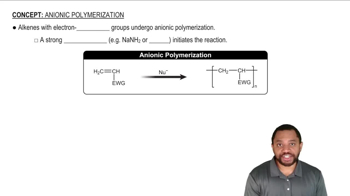
    Alkenes with electron withdrawing groups typically undergo anionic polymerization.
  • What is a common initiator used in anionic polymerization?

    A common initiator is a strong nucleophile such as butyllithium or sodium amide.
  • What role do electron withdrawing groups play in anionic polymerization?

    Electron withdrawing groups stabilize the negative charge formed during the reaction.
  • What are the three main steps in the mechanism of anionic polymerization?

    The three steps are initiation, propagation, and termination.
  • During initiation, what does the nucleophile attack?

    The nucleophile attacks the double bond of the alkene.
  • How is the negative charge stabilized after the nucleophile attacks the alkene?

    The negative charge is stabilized by the electron withdrawing group, such as a nitrile.
  • What happens during the propagation step of anionic polymerization?

    The monomer anion reacts with another monomer, forming a new anion through head-to-tail addition.
  • What is meant by 'head-to-tail' addition in propagation?

    The negatively charged 'head' of the growing chain attacks the 'tail' of a new monomer.
  • Why is anionic polymerization considered a 'living' polymerization?

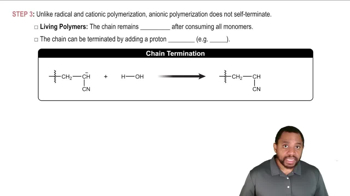
    Because the polymer chain remains active and can continue growing as long as monomers are available.
  • How is the anionic polymerization chain terminated?

    Termination occurs by adding a proton donor, such as water, to neutralize the carbanion.
  • What happens to the carbanion when water is added during termination?

    The carbanion deprotonates water, becoming neutral and stopping further polymerization.
  • How does anionic polymerization differ from radical and cationic polymerization in terms of termination?

    Anionic polymerization does not self-terminate and requires a proton donor to stop the reaction.
  • What is formed as a byproduct when water terminates the polymer chain?

    A hydroxide ion is formed as a byproduct.
  • Why is the number of repeating units in the polymer chain not specified?

    Because the chain can grow very long and is only limited by the amount of available monomer.
  • What is the similarity between the initiation step of anionic polymerization and conjugate addition?

    Both involve a nucleophile attacking a double bond, with stabilization by an electron withdrawing group.