Back

Atropisomers definitions

Control buttons has been changed to "navigation" mode.
1/14
  • Atropisomer

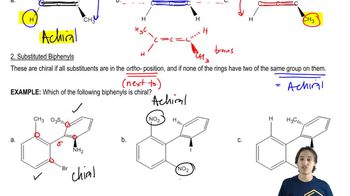
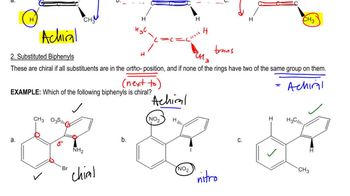
    A molecule lacking chiral centers but exhibiting chirality due to restricted rotation around a bond.
  • Chirality

    A property where a structure and its mirror image are non-superimposable, often due to spatial arrangement.
  • Allene

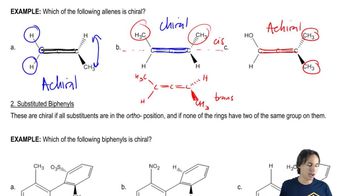
    A compound with two adjacent double bonds, potentially chiral if substituents allow E/Z isomerism.
  • Substituted Biphenyl

    A molecule with two phenyl rings connected by a single bond, where ortho substituents restrict rotation.
  • Trans Cyclooctene

    A ring structure with a trans double bond, forming distinct right- and left-handed forms due to restricted rotation.
  • BINAP

    A biphenyl derivative where bulky groups prevent rotation, leading to chirality without chiral centers.
  • Ortho Position

    The location on an aromatic ring directly adjacent to a reference point, often affecting rotational freedom.
  • Double Bond

    A chemical bond involving two shared pairs of electrons, restricting rotation between connected atoms.
  • Sigma Bond

    A single covalent bond formed by head-on orbital overlap, serving as the axis for possible rotation.
  • E/Z Isomerism

    A type of stereoisomerism arising from restricted rotation, distinguished by the arrangement of groups around a double bond.
  • Achirality

    A condition where a molecule is superimposable on its mirror image, often due to identical groups on key positions.
  • Phenyl Group

    A benzene ring acting as a substituent, commonly found in biphenyl structures.
  • Substituent

    An atom or group attached to a parent structure, influencing molecular properties like rotation and chirality.
  • Stereoisomer

    A compound with the same molecular formula and connectivity but differing in spatial arrangement.