Back

Atropisomers quiz

Control buttons has been changed to "navigation" mode.
1/15
  • What is an atropisomer?

    An atropisomer is a chiral compound that does not have any chiral centers but is chiral due to its inability to freely rotate.
  • Name two common examples of atropisomers.

    Two common examples of atropisomers are allenes and substituted biphenyls.
  • Why are atropisomers considered exceptions to the typical rules for predicting stereoisomers?

    They are exceptions because they are chiral without having any chiral centers, which is unusual compared to most chiral molecules.
  • What structural feature prevents rotation in allenes?

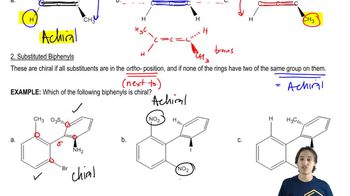
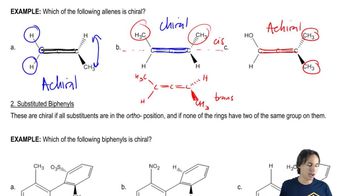
    Allenes have two adjacent double bonds, and double bonds cannot freely rotate, which locks their structure.
  • How can you determine if an allene is chiral?

    Visualize the allene as one large double bond; if it can form E or Z isomers, it is chiral.
  • What makes a substituted biphenyl chiral?

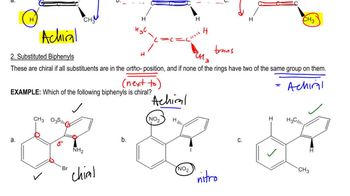
    A substituted biphenyl is chiral if the substituents in the ortho positions on both rings are different.
  • What does 'ortho position' mean in the context of biphenyls?

    Ortho position refers to the substituents that are adjacent to the single bond connecting the two rings.
  • When is a substituted biphenyl achiral?

    It is achiral if either ring has two identical substituent groups in the ortho positions.
  • Why is trans-cyclooctene considered an atropisomer?

    Trans-cyclooctene cannot freely rotate and can exist as right-handed and left-handed forms, making it chiral.
  • What is BINAP and why is it chiral?

    BINAP is a molecule similar to substituted biphenyls, where a large group prevents rotation, resulting in chirality.
  • Are atropisomers commonly emphasized in Organic Chemistry I?

    No, atropisomers are not commonly emphasized in Organic Chemistry I and may only be briefly mentioned.
  • What test can you use to determine the chirality of an allene?

    Pretend the allene is one big double bond and check if it can form E or Z isomers; if so, it is chiral.
  • What happens if an allene has two identical groups on one carbon?

    If an allene has two identical groups on one carbon, it cannot form E or Z isomers and is achiral.
  • How do substituents act in substituted biphenyls to prevent rotation?

    Substituents in the ortho positions act like 'teeth,' locking the rings and preventing free rotation.
  • What is the key difference between chirality in allenes and typical trigonal centers?

    Unlike typical trigonal centers, allenes can be chiral if they can form E or Z isomers, even without chiral centers.