Back

Axial vs Equatorial definitions

Control buttons has been changed to "navigation" mode.
1/13
  • Cyclohexane

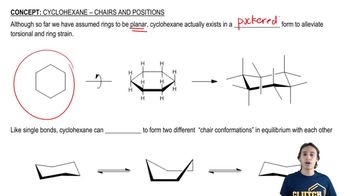
    A six-membered carbon ring that adopts non-planar shapes to minimize torsional and ring strain.
  • Chair Conformation

    A puckered, three-dimensional arrangement of a six-membered ring that eliminates most strain.
  • Boat Conformation

    An unstable, high-energy shape of a six-membered ring with close hydrogen interactions called flagpole interactions.
  • Ring Strain

    Destabilization in cyclic molecules due to non-ideal bond angles and eclipsing interactions.
  • Torsional Strain

    Repulsion caused by eclipsed bonds, especially hydrogens, increasing molecular energy.
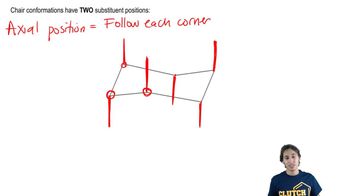
  • Axial Position

    A substituent orientation on a ring that points straight up or down from each carbon's corner.
  • Equatorial Position

    A substituent orientation on a ring that points slightly away from the axial direction, reducing steric interactions.
  • Flagpole Interaction

    Repulsive contact between hydrogens on the same side of a boat conformation, causing instability.
  • Bond Angle

    The geometric angle between two bonds at an atom, ideally 109.5° in cyclohexane to minimize strain.
  • Conformation

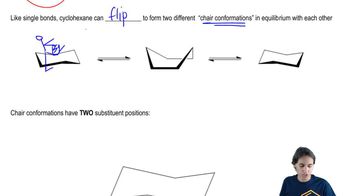
    A spatial arrangement of atoms in a molecule resulting from rotation around single bonds, not altering connectivity.
  • Equilibrium

    A dynamic state where two chair conformations interconvert, maintaining a constant ratio.
  • Substituent

    An atom or group attached to a ring carbon, occupying either an axial or equatorial position.
  • Cis-Trans Isomerism

    A type of stereoisomerism in rings determined by the relative positions of substituents, influenced by bond angles.