Back

Benzyne quiz

Control buttons has been changed to "navigation" mode.
1/15
  • What is the benzyne pathway in benzene chemistry?

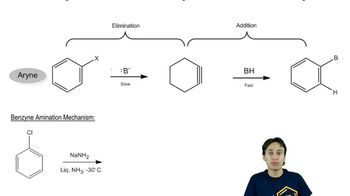
    The benzyne pathway is an elimination-addition mechanism involving the formation of a highly unstable intermediate called benzyne (or aryne), which features a triple bond within the benzene ring.
  • What is the first step in the benzyne mechanism?

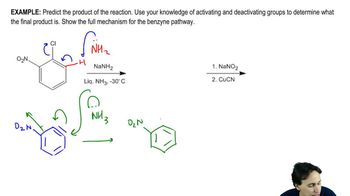
    The first step is a beta elimination using a strong base, which removes a hydrogen and a leaving group (like a halide) to form the benzyne intermediate.
  • Why is the benzyne intermediate considered highly unstable?

    Benzyne is unstable because it forces a triple bond into the benzene ring, creating significant angle strain since the bond angle is forced to 120° instead of the preferred 180°.
  • What type of base is typically used to generate benzyne from an aryl halide?

    A very strong base, such as NH2− (amide ion), is typically used to generate benzyne from an aryl halide.
  • After forming benzyne, what is the next step in the mechanism?

    The next step is the addition of a nucleophile (often the conjugate acid of the base used) to one side of the triple bond, forming a new substituted benzene.
  • How can the benzyne pathway be used to synthesize aniline?

    By treating an aryl halide with NH2−, benzyne is formed and then NH2− adds to the ring, ultimately yielding aniline after proton exchange.
  • What is the difference between the benzyne pathway and the SNAr mechanism?

    The benzyne pathway involves elimination first and then addition, while SNAr involves addition first (nucleophilic attack) followed by elimination.
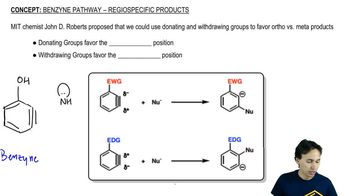
  • What determines the regioselectivity of nucleophilic attack on an asymmetrical benzyne?

    Regioselectivity is determined by the substituents on the ring: electron-donating groups favor ortho attack, while electron-withdrawing groups favor meta attack.
  • Why do electron-donating groups favor ortho substitution in the benzyne pathway?

    Electron-donating groups stabilize the negative charge formed during the mechanism when it is further away, making ortho substitution more favorable.
  • Why do electron-withdrawing groups favor meta substitution in the benzyne pathway?

    Electron-withdrawing groups stabilize the negative charge when it is closer to them, so meta substitution is favored.
  • What is the role of the conjugate acid in the benzyne mechanism?

    The conjugate acid acts as a nucleophile, attacking the benzyne intermediate to form the substituted product.
  • What is the typical leaving group in the benzyne elimination step?

    A halide, such as Cl− or Br−, is typically the leaving group in the elimination step that forms benzyne.
  • What is the bond angle of a triple bond, and why is this problematic in benzyne?

    A triple bond prefers a 180° bond angle, but in benzyne, it is forced into a 120° angle, causing significant strain and instability.
  • In the benzyne mechanism, what happens after the nucleophile adds to the triple bond?

    After nucleophilic addition, a negative charge is formed on the ring, which is then neutralized by proton exchange to yield the final substituted product.
  • How does the benzyne pathway differ from electrophilic aromatic substitution (EAS)?

    In EAS, addition occurs first followed by elimination, whereas in the benzyne pathway, elimination occurs first to form benzyne, followed by nucleophilic addition.