Back

Carbene definitions

Control buttons has been changed to "navigation" mode.
1/15
  • Cyclopropanation

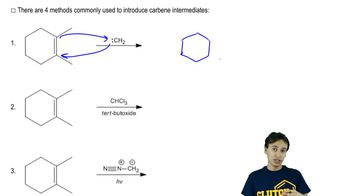
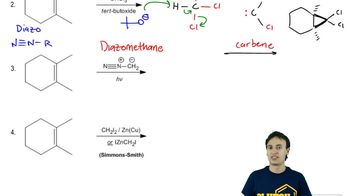
    Transformation where a double bond and a reactive species yield a three-membered ring, often resulting in a cis product.
  • Carbene

    Highly reactive intermediate with a neutral charge, a lone pair, and only six valence electrons, violating the octet rule.
  • Carbenoid

    Species that behaves like a carbene in reactions but is not a true carbene, often involved in cyclopropanation.
  • Cyclopropane

    Three-membered ring hydrocarbon formed by the addition of a methylene group to a double bond.
  • Alpha Elimination

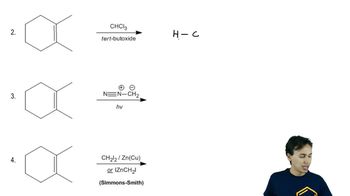
    Process where a hydrogen and a leaving group are removed from the same carbon, generating a reactive intermediate.
  • Diazomethane

    Yellow, volatile compound that releases nitrogen gas upon light exposure, forming a reactive intermediate for ring formation.
  • Diazo Group

    Functional group with two nitrogen atoms connected by a triple bond, prone to releasing nitrogen gas under energy input.
  • Simmons-Smith Reaction

    Method using diiodomethane and a zinc-copper couple to generate a carbenoid for cyclopropane synthesis.
  • Diiodomethane

    Methane derivative with two iodine atoms, used as a precursor in the Simmons-Smith reaction.
  • Zinc-Copper Couple

    Mixture of zinc and copper metals that activates diiodomethane to form a reactive carbenoid species.
  • Iodozinc Methylene

    Reactive intermediate formed from diiodomethane and zinc-copper, serving as the active species in the Simmons-Smith reaction.
  • Enantiomer

    Non-superimposable mirror image of a molecule, relevant when cyclopropanation creates asymmetric centers.
  • Halogen

    Element from group 17, such as chlorine or bromine, often used to substitute hydrogens in reactive intermediates.
  • Tert-Butoxide

    Strong, bulky base commonly used to abstract protons and initiate elimination reactions leading to reactive intermediates.
  • Octet Rule

    Principle stating atoms tend to have eight electrons in their valence shell, often violated by reactive intermediates.