Back

Carbene quiz

Control buttons has been changed to "navigation" mode.
1/15
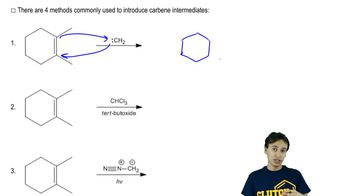
  • What is the product when a double bond reacts with a carbene or carbenoid in a cyclopropanation reaction?

    The product is a cyclopropane, a three-membered ring structure.
  • Why are carbenes considered highly reactive intermediates?

    Carbenes are highly reactive because they violate the octet rule, having only six electrons around the carbon atom.
  • What is the formal charge on a typical carbene?

    A typical carbene has a formal charge of zero.
  • What happens to the stereochemistry of the cyclopropane ring formed in cyclopropanation?

    The cyclopropane ring is always formed as a cis product due to ring strain and the mechanism of addition.
  • How can the hydrogens on a carbene be substituted in cyclopropanation reactions?

    The hydrogens can be replaced with other atoms like halogens, such as bromine or chlorine.
  • What is the role of tert-butoxide in generating a carbene from a trihalogenated compound?

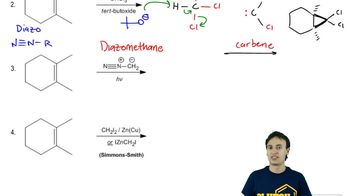
    Tert-butoxide acts as a strong base, abstracting a hydrogen and facilitating alpha elimination to generate the carbene.
  • What is alpha elimination in the context of carbene generation?

    Alpha elimination involves removing a hydrogen and a halogen from the same carbon to form a carbene.
  • What is diazomethane and how does it generate a carbene?

    Diazomethane is a compound with a diazo group that, upon exposure to light or heat, releases nitrogen gas and forms a carbene.
  • Why is nitrogen gas so stable when released from diazomethane?

    Nitrogen gas is stable due to its strong triple bond and inert nature, making it unlikely to react further.
  • What is the Simmons-Smith reaction used for?

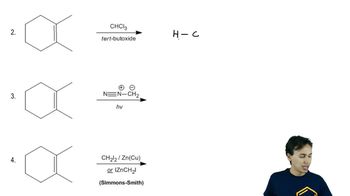
    The Simmons-Smith reaction is used to add a cyclopropane ring to a double bond using diiodomethane and a zinc-copper couple.
  • What is the key reagent formed in the Simmons-Smith reaction?

    The key reagent is iodozincmethyl iodide, also known as the Simmons-Smith reagent.
  • Does the final cyclopropane product from the Simmons-Smith reaction contain iodine atoms?

    No, the final cyclopropane product does not contain iodine atoms; the iodines are removed during the reaction.
  • What is the difference between a carbene and a carbenoid?

    A carbene is a neutral carbon species with two nonbonded electrons, while a carbenoid is a compound that behaves like a carbene but is not a true carbene.
  • How many main methods for cyclopropanation were discussed in the lesson?

    Four main methods for cyclopropanation were discussed: direct carbene addition, alpha elimination, diazomethane, and the Simmons-Smith reaction.
  • What is the general mechanism shared by all cyclopropanation reactions discussed?

    All cyclopropanation reactions involve the addition of a CH2 group to a double bond, forming a three-membered cyclopropane ring.