Back

Carbocation Intermediate Rearrangements definitions

Control buttons has been changed to "navigation" mode.
1/15
  • Carbocation

    A positively charged carbon species that seeks electron density and can undergo rearrangement to increase stability.
  • Rearrangement

    A process where a structure changes to a more stable form, often involving the migration of atoms or groups within a molecule.
  • Stability

    A measure of how favorable or persistent a molecular structure is, often increased by more alkyl group attachments to a carbocation.
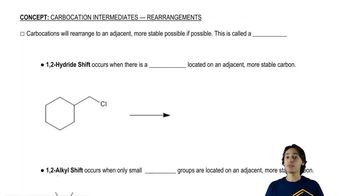
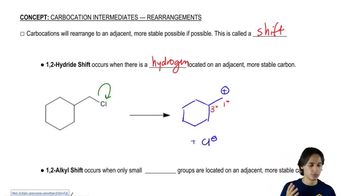
  • Shift

    The migration of a group or atom from one atom to an adjacent atom, resulting in a new, often more stable, molecular structure.
  • 1,2-Hydride Shift

    A rearrangement where a hydrogen atom with its bonding electrons moves from one carbon to an adjacent carbocation, increasing stability.
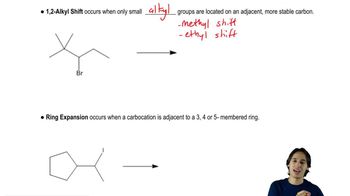
  • 1,2-Alkyl Shift

    A rearrangement involving the migration of an alkyl group, such as methyl or ethyl, from one carbon to a neighboring carbocation.
  • Methyl Shift

    A specific alkyl shift where a methyl group moves to a carbocation, typically when no hydrogens are available for a hydride shift.
  • Ethyl Shift

    A less common alkyl shift where an ethyl group migrates to a carbocation, requiring more energy than a methyl shift.
  • Ring Expansion

    A rearrangement where a carbocation adjacent to a small ring causes the ring to increase in size, relieving strain and increasing stability.
  • Activation Energy

    The energy required to initiate a rearrangement, higher for larger group shifts like ethyl compared to hydride or methyl shifts.
  • Alkyl Group

    A hydrocarbon fragment, such as methyl or ethyl, that can migrate during rearrangement to stabilize a carbocation.
  • Tertiary Carbocation

    A carbocation bonded to three alkyl groups, representing a highly stable carbocation form due to electron-donating effects.
  • Primary Carbocation

    A carbocation attached to only one alkyl group, making it highly unstable and prone to rearrangement.
  • Secondary Carbocation

    A carbocation connected to two alkyl groups, intermediate in stability between primary and tertiary forms.
  • Bond Angle Strain

    A destabilizing effect in small rings that promotes ring expansion during carbocation rearrangement.