Back

Carbocation Stability definitions

Control buttons has been changed to "navigation" mode.
1/14
  • Carbocation

    A carbon atom with three bonds and an empty orbital, carrying a positive charge due to a missing bond.
  • Intermediate

    A high-energy species formed during a reaction, existing between reactants and products, often isolatable.
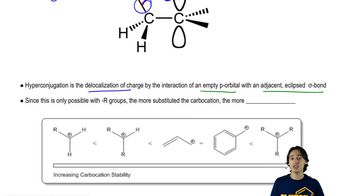
  • Hyperconjugation

    Stabilization from electron density shared by adjacent sigma bonds with an empty p orbital on a positively charged carbon.
  • Sigma Bond

    A single covalent bond formed by the direct overlap of atomic orbitals, capable of donating electron density in stabilization.
  • R Group

    An alkyl substituent attached to a molecule, often providing hydrogens for electron donation in stabilization.
  • Primary Carbocation

    A positively charged carbon attached to only one alkyl group, offering minimal stabilization and high instability.
  • Secondary Carbocation

    A positively charged carbon bonded to two alkyl groups, more stable than primary due to increased electron donation.
  • Tertiary Carbocation

    A positively charged carbon connected to three alkyl groups, achieving maximum stabilization via extensive hyperconjugation.
  • Allylic Carbocation

    A positively charged carbon adjacent to a double bond, stabilized by resonance delocalizing the positive charge.
  • Benzylic Carbocation

    A positively charged carbon next to a benzene ring, stabilized by resonance with the aromatic system.
  • Resonance

    Delocalization of charge across multiple atoms, increasing stability by spreading out electron deficiency.
  • Delocalization

    Distribution of electron density or charge over several atoms, reducing localized instability.
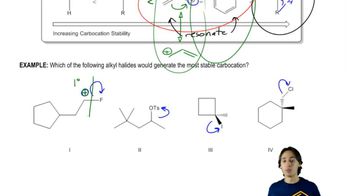
  • Alkyl Halide

    A compound containing a halogen atom bonded to an alkyl group, capable of forming a carbocation upon halide departure.
  • Empty Orbital

    A region around an atom lacking electrons, often associated with a positive charge and high reactivity.