Carbocation Stability quiz #1 Flashcards

Carbocation Stability quiz #1
Control buttons has been changed to "navigation" mode.
1/19
  • Which type of carbocation is the most stable based on alkyl substitution?
    A tertiary carbocation is the most stable due to extensive hyperconjugation from three alkyl groups.
  • How does the stability of primary, secondary, and tertiary carbocations compare?
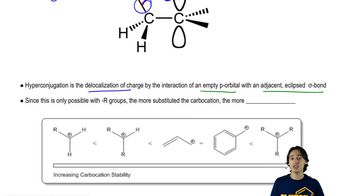
    Tertiary carbocations are more stable than secondary, which are more stable than primary carbocations.
  • Which carbocation is expected to be the most stable: primary, secondary, tertiary, allylic, or benzylic?
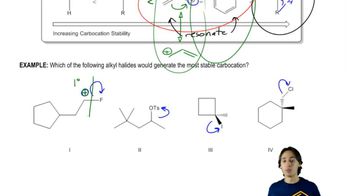
    Tertiary carbocations are the most stable, followed by benzylic and allylic (due to resonance), then secondary, and finally primary as the least stable.
  • Which type of carbocation is likely to undergo rearrangement to form a more stable carbocation?
    Carbocations that are not already tertiary or highly stabilized by resonance (such as primary or secondary carbocations) are likely to rearrange to form a more stable carbocation.
  • What is the main reason alkyl substituents stabilize carbocations?
    Alkyl substituents stabilize carbocations through hyperconjugation, where adjacent sigma bonds donate electron density to the empty p-orbital of the carbocation.
  • Which type of alcohol, when ionized, produces the most stable carbocation intermediate?
    A tertiary alcohol produces the most stable carbocation intermediate upon ionization.
  • Which type of alkyl halide will form the most stable carbocation upon loss of the halide?
    A tertiary alkyl halide will form the most stable carbocation upon loss of the halide.
  • What is the most effective way to stabilize a carbocation?
    The most effective way to stabilize a carbocation is by increasing the number of alkyl groups attached to the positively charged carbon, enhancing hyperconjugation.
  • Which carbocations are most likely to undergo rearrangement?
    Primary and secondary carbocations are most likely to undergo rearrangement to form more stable carbocations, such as tertiary or resonance-stabilized carbocations.
  • What is a true statement about carbocation stability?
    Carbocation stability increases with the number of alkyl groups attached to the positively charged carbon and is further enhanced by resonance with adjacent double bonds or aromatic rings.
  • In the dehydration of cyclohexanol, what is the most stable carbocation intermediate formed?
    The most stable carbocation intermediate formed during the dehydration of cyclohexanol is a secondary carbocation, as the positive charge is on a carbon bonded to two other carbons.
  • How would you describe a carbocation with three alkyl groups attached to the positively charged carbon?
    A carbocation with three alkyl groups attached to the positively charged carbon is described as a tertiary carbocation.
  • How should you rank primary, secondary, and tertiary carbocations in order of decreasing stability?
    Tertiary > Secondary > Primary
  • How does a 1,2-shift increase carbocation stability?
    A 1,2-shift moves an alkyl or hydride group from an adjacent carbon to the carbocation center, converting a less stable carbocation (such as secondary) into a more stable one (such as tertiary).
  • Will a secondary carbocation rearrange if a tertiary carbocation can be formed by a 1,2-shift?
    Yes, a secondary carbocation will rearrange via a 1,2-shift if it can form a more stable tertiary carbocation.
  • What type of carbocation structure can rearrange by a 1,2-alkyl shift to form a tertiary carbocation?
    A secondary carbocation adjacent to a tertiary carbon can rearrange by a 1,2-alkyl shift to form a tertiary carbocation.
  • How can you modify a carbocation intermediate to show its most stable form?
    You can modify a carbocation intermediate to its most stable form by allowing a 1,2-shift (alkyl or hydride) to occur, resulting in a tertiary or resonance-stabilized carbocation.
  • How should you rank carbocations from most stable to least stable based on substitution?
    Tertiary > Secondary > Primary
  • Which type of carbocation is not likely to rearrange?
    A tertiary carbocation is not likely to rearrange because it is already the most stable form.