Organic Chemistry
My Course
Learn
Exam Prep
AI Tutor
Study Guides
Textbook Solutions
Flashcards
Explore
Try the app
My Course
Learn
Exam Prep
AI Tutor
Study Guides
Textbook Solutions
Flashcards
Explore
Try the app
Back
Cationic Polymerization definitions
You can tap to flip the card.
Cationic Polymerization
You can tap to flip the card.
👆
Cationic Polymerization
Chain-growth process where alkenes with electron-donating groups form polymers via carbocation intermediates.
Track progress
Control buttons has been changed to "navigation" mode.
1/15
Related flashcards
Recommended videos
Cationic Polymerization quiz
Cationic Polymerization
15 Terms
1:34
Cationic Polymerization Example 1
516
views
1:12
Cationic Polymerization Concept 4
525
views
0:52
Cationic Polymerization Concept 3
565
views
Terms in this set (15)
Hide definitions
Cationic Polymerization
Chain-growth process where alkenes with electron-donating groups form polymers via carbocation intermediates.
Alkene
Hydrocarbon containing a carbon-carbon double bond, serving as the monomer in this polymerization.
Electron-Donating Group
Substituent that stabilizes carbocations by supplying electron density, enhancing reactivity in the mechanism.
Electrophile
Species that initiates the reaction by accepting electrons, often a proton or Lewis acid in this context.
Lewis Acid
Electron pair acceptor, such as boron trifluoride, that activates the monomer for polymerization.
Boron Trifluoride
Common Lewis acid catalyst forming an adduct with water to generate the initiating proton.
Adduct
Intermediate complex formed between a Lewis acid and a Lewis base, facilitating proton donation.
Carbocation
Positively charged carbon intermediate crucial for chain propagation in the polymerization process.
Initiation
First step where the monomer is activated by protonation, generating a reactive carbocation.
Propagation
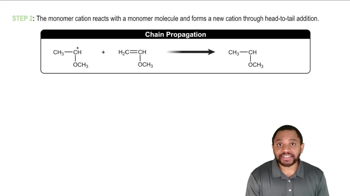
Step involving sequential addition of monomers to the growing chain via head-to-tail mechanism.
Termination
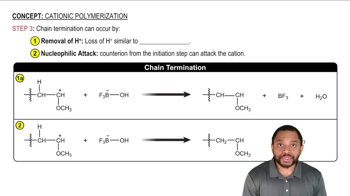
Final step where chain growth stops, typically by proton loss or nucleophilic attack.
Nucleophilic Attack
Process where a counter ion donates electrons to the carbocation, ending the polymer chain.
Beta Elimination
Mechanism resembling proton removal from the chain, resulting in alkene formation and chain termination.
Counter Ion
Ion generated during initiation that can later neutralize the carbocation, terminating the chain.
Head-to-Tail Addition
Pattern where the reactive end of the chain adds to the less substituted end of the incoming monomer.