Back

Cationic Polymerization quiz

Control buttons has been changed to "navigation" mode.
1/15
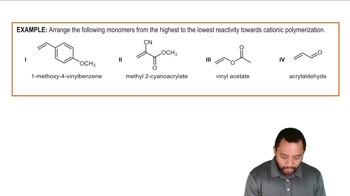
  • What type of alkenes typically undergo cationic polymerization?

    Alkenes with electron-donating groups typically undergo cationic polymerization.
  • What initiates the cationic polymerization reaction?

    An electrophile, such as H+ or a Lewis acid like boron trifluoride, initiates the reaction.
  • What are the three main steps in the cationic polymerization mechanism?

    The three main steps are initiation, propagation, and termination.
  • How is the H+ ion generated in the initiation step?

    A Lewis acid, typically boron trifluoride, reacts with water to form an adduct that donates an H+ ion.
  • What happens to the alkene during the initiation step?

    The alkene uses its pi bond to grab the H+ ion, forming a carbocation.
  • Why are electron-donating groups important in cationic polymerization?

    Electron-donating groups stabilize the carbocation intermediate formed during the reaction.
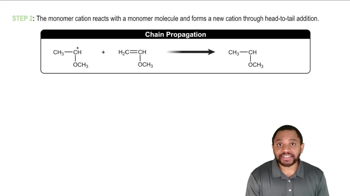
  • Describe the propagation step in cationic polymerization.

    The monomer cation reacts with another monomer molecule, forming a new cation through head-to-tail addition.
  • What is meant by 'head-to-tail' addition in propagation?

    It refers to the pi bond of a new monomer attacking the carbocation at the end of the growing chain.
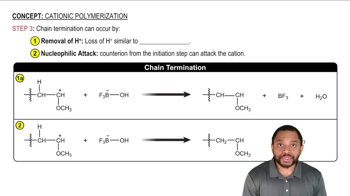
  • What are the two possible ways termination can occur in cationic polymerization?

    Termination can occur by removal of H+ (similar to beta elimination) or by nucleophilic attack by a counter ion.
  • What is the result of termination by H+ removal?

    The result is the formation of an alkene and regeneration of boron trifluoride and water.
  • How does nucleophilic attack terminate the polymerization?

    A counter ion from the initiation step attacks the carbocation, neutralizing the charge and ending the chain.
  • What role does boron trifluoride play in the mechanism?

    Boron trifluoride acts as a Lewis acid, helping to generate the H+ ion needed for initiation.
  • What happens to boron trifluoride at the end of the reaction?

    Boron trifluoride is regenerated during the termination step.
  • What is the significance of the carbocation intermediate in this mechanism?

    The carbocation intermediate allows for chain growth and is stabilized by electron-donating groups.
  • How does the mechanism of cationic polymerization exemplify electrophilic addition?

    The mechanism involves an electrophile (H+) adding to an alkene, forming a carbocation that propagates the chain.