Back

Test 3:Disubstituted Cycloalkanes quiz

Control buttons has been changed to "navigation" mode.
1/15
  • What is the third test for chirality in organic chemistry specifically used for?

    The third test is a shortcut used specifically for disubstituted cycloalkanes to quickly determine chirality.
  • What does 'geminal' mean in the context of disubstituted cycloalkanes?

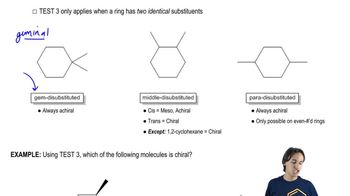
    Geminal means that two substituents are attached to the same carbon atom in the ring.
  • Are geminal disubstituted cycloalkanes chiral or achiral, and why?

    They are always achiral because there is no chiral center present.
  • What does 'para' mean when describing disubstituted cycloalkanes?

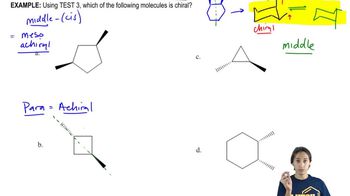
    'Para' means that the two substituents are located across from each other, or on opposite sides of the ring.
  • On what type of cycloalkane rings can para disubstitution occur?

    Para disubstitution can only occur on even-numbered rings, such as 4, 6, or 8-membered rings.
  • Are para disubstituted cycloalkanes chiral or achiral?

    They are always achiral; you do not need to test for chirality.
  • What is meant by 'middle disubstituted' cycloalkanes?

    Middle disubstituted cycloalkanes have substituents that are neither geminal nor para, but somewhere in between on the ring.
  • How does the orientation (cis or trans) of substituents affect the chirality of middle disubstituted cycloalkanes?

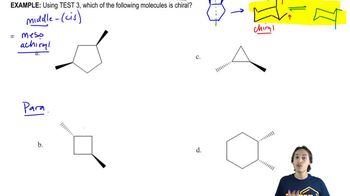
    If the substituents are cis, the compound is meso (achiral); if trans, the compound is chiral.
  • What is the general rule for the chirality of cis-1,2-disubstituted cycloalkanes?

    Cis-1,2-disubstituted cycloalkanes are generally considered achiral (meso), except for certain controversial cases.
  • Why is the chirality of cis-1,2-cyclohexane considered controversial?

    Because some professors argue it is chiral due to the chair conformation, while most textbooks and professors consider it achiral due to rapid chair flipping (equilibrium).
  • In the chair conformation of cis-1,2-cyclohexane, what is the arrangement of the substituents?

    One substituent is axial and the other is equatorial, both on the same face of the ring.
  • What argument do professors use to claim cis-1,2-cyclohexane is achiral?

    They argue that because the molecule rapidly interconverts between two chair forms, the average structure is achiral.
  • What should students do if they are unsure about the chirality of cis-1,2-cyclohexane for their course?

    Students should ask their professor directly to clarify which convention to use for exams.
  • What is the shortcut rule for determining chirality in trans middle disubstituted cycloalkanes?

    Trans middle disubstituted cycloalkanes are always chiral; no further testing is needed.
  • Why is it important to memorize these shortcut rules for disubstituted cycloalkanes?

    Memorizing these shortcuts saves time on exams and homework by quickly determining chirality without detailed analysis.