Chirality quiz #4 Flashcards

Chirality quiz #4
Control buttons has been changed to "navigation" mode.
1/40
  • What is the significance of chirality in the study of chiral supramolecular assemblies for photonic applications?
    Chirality is significant in the study of chiral supramolecular assemblies for photonic applications because it affects their structure and function, as the arrangement of chiral units can influence the assembly's behavior in light-based technologies.
  • How does chirality affect the interaction of chiral molecules with cofactors?
    Chirality affects the interaction of chiral molecules with cofactors by influencing their binding and activity, as different enantiomers can have different interactions with chiral cofactor structures.
  • Which statement about enantiomers is false?
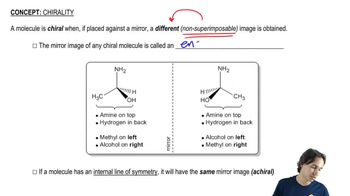
    A false statement about enantiomers would be that they are superimposable mirror images; in reality, enantiomers are non-superimposable mirror images of each other.
  • How can you determine if a molecule is chiral?
    A molecule is chiral if it is non-superimposable on its mirror image, typically due to the absence of an internal line of symmetry and the presence of a carbon atom bonded to four different groups.
  • How do you determine if a compound is chiral?
    A compound is chiral if it lacks an internal line of symmetry and its mirror image is non-superimposable.
  • What is a chiral molecule?
    A chiral molecule is one that is not superimposable on its mirror image, usually due to the presence of a carbon atom bonded to four different groups.
  • How do you determine the number of chiral centers in a structure?
    Count the number of carbon atoms each bonded to four different substituents; each such carbon is a chiral center.
  • How many chirality centers are present in a 2-ketohexose?
    A 2-ketohexose typically has three chirality centers, as the ketone at position 2 prevents chirality there, but the remaining carbons (except the terminal ones) can be chiral if bonded to four different groups.
  • What is a meso compound?
    A meso compound is an achiral molecule that contains multiple stereocenters but has an internal plane of symmetry, making it superimposable on its mirror image.
  • How do you determine if a molecule is chiral?
    A molecule is chiral if it lacks an internal line of symmetry and its mirror image is non-superimposable.
  • How do you determine the number of chiral centers in a compound?
    Identify all carbon atoms bonded to four different substituents; each is a chiral center.
  • How do you identify the enantiomer of a given substance?
    The enantiomer of a substance is its non-superimposable mirror image, with all chiral centers having opposite configurations.
  • How do you determine the number of stereogenic centers in a molecule?
    Count the number of carbon atoms each bonded to four different substituents; these are the stereogenic centers.
  • How many different substituents are required on a carbon atom for it to be chiral?
    A carbon atom must be bonded to four different substituents to be chiral.
  • How do you determine if a compound is chiral?
    A compound is chiral if it lacks an internal line of symmetry and its mirror image is non-superimposable.
  • Which compounds can exist as optical isomers (enantiomers)?
    Compounds that are chiral, meaning they lack an internal line of symmetry and have at least one stereocenter, can exist as optical isomers (enantiomers).
  • How do you determine the absolute configuration of a stereocenter in a compound?
    Assign priorities to the four groups attached to the stereocenter and use the Cahn-Ingold-Prelog rules to determine if the configuration is R or S.
  • How do you determine if two structures represent identical compounds or a pair of enantiomers?
    If the structures are superimposable, they are identical; if they are non-superimposable mirror images, they are enantiomers.
  • How do you identify the enantiomer of a compound?
    The enantiomer is the non-superimposable mirror image of the compound, with all chiral centers having opposite configurations.
  • How do you determine if a compound has an asymmetric center?
    A compound has an asymmetric center if it contains a carbon atom bonded to four different groups.
  • What describes an achiral molecule?
    An achiral molecule is superimposable on its mirror image, usually due to the presence of an internal line of symmetry.
  • How do you determine if a molecule is chiral or achiral?
    A molecule is chiral if it lacks an internal line of symmetry and is non-superimposable on its mirror image; otherwise, it is achiral.
  • What determines the size of the curl in a chiral molecule?
    The size of the curl is not a standard term in chirality; chirality is determined by the arrangement of groups around a stereocenter.
  • How do you classify compounds as chiral, achiral (but not meso), or meso?
    Chiral compounds lack an internal line of symmetry and are non-superimposable on their mirror images; achiral compounds are superimposable; meso compounds have multiple stereocenters and an internal plane of symmetry.
  • How do you identify a structure as achiral, chiral, or meso?
    A structure is chiral if it lacks symmetry and is non-superimposable on its mirror image, achiral if it is superimposable, and meso if it has stereocenters and an internal plane of symmetry.
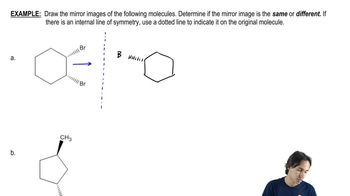
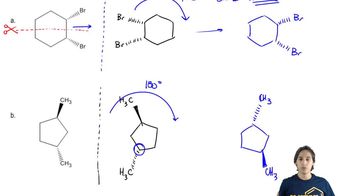
  • How do you draw the enantiomer of a molecule?
    To draw the enantiomer, invert the configuration at all chiral centers, creating the non-superimposable mirror image.
  • How do you classify a pair of compounds as the same compound, enantiomers, or diastereomers?
    If the compounds are superimposable, they are the same; if they are non-superimposable mirror images, they are enantiomers; if they are stereoisomers but not mirror images, they are diastereomers.
  • How do you determine if a molecule is chiral or achiral?
    A molecule is chiral if it lacks an internal line of symmetry and is non-superimposable on its mirror image; otherwise, it is achiral.
  • How do you identify the enantiomer of a compound?
    The enantiomer is the non-superimposable mirror image of the compound, with all chiral centers having opposite configurations.
  • How do you identify all chirality centers in a structure?
    Locate all carbon atoms bonded to four different groups; these are the chirality centers.
  • How do you classify a molecule as chiral or achiral?
    A molecule is chiral if it lacks an internal line of symmetry and is non-superimposable on its mirror image; otherwise, it is achiral.
  • How do you determine the number of stereogenic centers in a compound?
    Count the number of carbon atoms each bonded to four different substituents; these are the stereogenic centers.
  • How do you identify chiral centers in a cholesterol derivative?
    Identify all carbon atoms bonded to four different groups in the cholesterol derivative; these are the chiral centers.
  • How do you draw the stereoisomeric products for a reaction?
    Draw all possible products differing in the configuration at each chiral center, representing all stereoisomers.
  • How do you determine if a molecule is chiral?
    A molecule is chiral if it lacks an internal line of symmetry and is non-superimposable on its mirror image.
  • How do you identify the meso isomer of a structure?
    A meso isomer has multiple stereocenters and an internal plane of symmetry, making it achiral.
  • How do you identify meso compounds?
    Meso compounds have multiple stereocenters and an internal plane of symmetry, making them achiral.
  • How do you identify the number of chiral centers in a compound?
    Count the number of carbon atoms bonded to four different groups; each is a chiral center.
  • How do you determine if a structure is aromatic?
    A structure is aromatic if it follows Huckel's rule (4n+2 π electrons) and is cyclic, planar, and fully conjugated; otherwise, it is not aromatic.
  • How do you determine the number of chiral centers in remdesivir?
    Count the number of carbon atoms in remdesivir that are bonded to four different groups; each is a chiral center.