Back

Cis vs Trans Conformations definitions

Control buttons has been changed to "navigation" mode.
1/12
  • Cyclohexane

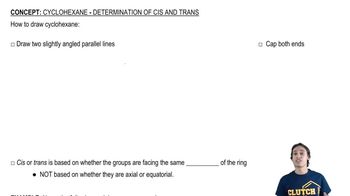
    A six-membered carbon ring with a unique three-dimensional shape, often drawn using parallel lines capped at both ends.
  • Hexagonal Ring

    A closed six-sided structure representing the backbone of certain organic molecules, notably cyclohexane.
  • Axial Position

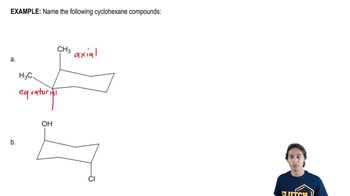
    A spatial orientation in cyclohexane where substituents point perpendicular to the ring plane, either straight up or down.
  • Equatorial Position

    A spatial orientation in cyclohexane where substituents extend outward, roughly parallel to the ring plane.
  • Cis Configuration

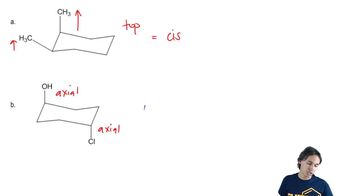
    A situation where two substituents on a ring are located on the same face, either both above or both below the plane.
  • Trans Configuration

    A situation where two substituents on a ring are located on opposite faces, one above and one below the plane.
  • Substituent

    An atom or group attached to the main structure of a molecule, such as a ring, influencing its properties and orientation.
  • Face

    The top or bottom side of a ring structure, used to determine the relative positions of substituents.
  • Parallel Lines

    A drawing technique involving two slightly angled lines, serving as the foundation for sketching cyclohexane.
  • Cap

    A curved or angled line added to each end of parallel lines to complete the cyclohexane ring drawing.
  • Misconception

    A common incorrect belief, such as equating axial or equatorial positions with cis or trans configurations.
  • Direction

    The orientation (up or down) of a substituent relative to the ring, crucial for distinguishing cis and trans forms.