Organic Chemistry
My Course
Learn
Exam Prep
AI Tutor
Study Guides
Textbook Solutions
Flashcards
Explore
My Course
Learn
Exam Prep
AI Tutor
Study Guides
Textbook Solutions
Flashcards
Explore
Back
Coordination Complexes definitions
You can tap to flip the card.
Define:
Coordination Complex
You can tap to flip the card.
👆
Coordination Complex
Structure with a central transition metal ion bonded to ligands, often stabilized by counter ions to maintain charge neutrality.
Track progress
Control buttons has been changed to "navigation" mode.
1/15
Related flashcards
Related practice
Recommended videos
Coordination Complexes quiz
Coordination Complexes
10 Terms
Coordination Complexes quiz #1
Coordination Complexes
10 Terms
27. Transition Metals
6 topics
14 problems
Chapter
Johnny
Guided course
05:02
Coordination Complexes
Johnny Betancourt
673
views
Guided course
03:05
Coordination Complexes Exercise 1
Johnny Betancourt
753
views
Guided course
02:16
Coordination Complexes Exercise 2
Johnny Betancourt
680
views
Terms in this set (15)
Hide definitions
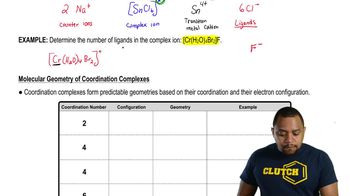
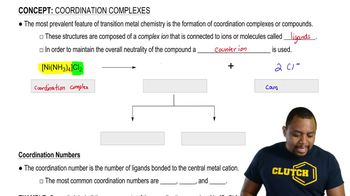
Coordination Complex
Structure with a central transition metal ion bonded to ligands, often stabilized by counter ions to maintain charge neutrality.
Transition Metal
Central atom in a complex, typically a d-block element, whose charge and electron configuration influence complex geometry.
Ligand
Molecule or ion directly bonded to a central metal, can be neutral or negatively charged, determining the coordination number.
Counter Ion
Ion outside the coordination sphere that balances the overall charge of the coordination complex.
Complex Ion
Charged species consisting of a central metal ion surrounded by ligands, enclosed in brackets in chemical formulas.
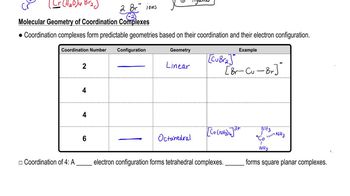
Coordination Number
Count of ligands directly attached to the central metal ion, commonly 2, 4, or 6 in coordination chemistry.
Linear Geometry
Spatial arrangement where two ligands are positioned 180° apart around a central metal, typical for coordination number 2.
Tetrahedral Geometry
Three-dimensional shape with four ligands symmetrically arranged around a central atom, common for d10 metals.
Square Planar Geometry
Arrangement where four ligands occupy the corners of a square in a single plane around the central metal, typical for d8 metals.
Octahedral Geometry
Shape where six ligands are symmetrically arranged around a central atom, forming an eight-faced polyhedron.
Electron Configuration
Distribution of electrons among atomic orbitals in the central metal, influencing the geometry of complexes.
d10 Configuration
Electron arrangement with ten electrons in the d orbitals, favoring tetrahedral geometry in four-coordinate complexes.
d8 Configuration
Electron arrangement with eight electrons in the d orbitals, favoring square planar geometry in four-coordinate complexes.
Neutral Ligand
Uncharged molecule, such as ammonia or water, that donates electron pairs to the central metal in a complex.
Negative Ligand
Anion, like cyanide or azide, that donates electron pairs to the central metal, contributing to the complex's properties.