Organic Chemistry
My Course
Learn
Exam Prep
AI Tutor
Study Guides
Textbook Solutions
Flashcards
Explore
Try the app
My Course
Learn
Exam Prep
AI Tutor
Study Guides
Textbook Solutions
Flashcards
Explore
Try the app
Back
Cross-Coupling General Reactions definitions
You can tap to flip the card.
Cross Coupling Reaction
You can tap to flip the card.
👆
Cross Coupling Reaction
Synthetic process combining a carbon halide and a coupling agent, forming new carbon-carbon bonds via a transition metal catalyst.
Track progress
Control buttons has been changed to "navigation" mode.
1/15
Related flashcards
Related practice
Recommended videos
Cross-Coupling General Reactions quiz
Cross-Coupling General Reactions
15 Terms
Heck Reaction
35. Transition Metals
7 problems
Topic

Johnny
27. Transition Metals
6 topics
14 problems
Chapter
Johnny
Guided course
04:10
Overview of Cross-Coupling General Reactions
941
views
6
rank
Guided course
03:28
Cross-Coupling Reaction Mechanisms
987
views
6
rank
Guided course
02:46
Cross-Coupling Reaction Mechanisms Example 3
855
views
5
rank
Terms in this set (15)
Hide definitions
Cross Coupling Reaction
Synthetic process combining a carbon halide and a coupling agent, forming new carbon-carbon bonds via a transition metal catalyst.
Transition Metal Catalyst
Central metal species, often palladium or nickel, facilitating bond formation and following the 18 or 16 electron rule.
18 Electron Rule
Stability guideline for transition metals, where achieving 18 valence electrons mimics noble gas configuration.
16 Electron Rule
Alternative stability guideline for certain transition metals, especially those with valence groups 8 to 11.
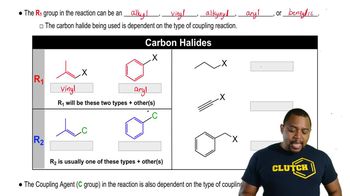
Carbon Halide
Organic molecule containing a carbon atom bonded to a halogen, serving as a key reactant in coupling reactions.
Coupling Agent
Reactant providing a carbon group, typically vinyl or aryl, that combines with a carbon halide to form the product.
Ligand
Molecule or ion bound to a transition metal, influencing its reactivity and electron count during the catalytic cycle.
Oxidative Addition
Mechanistic stage where a transition metal inserts into a carbon-halide bond, increasing its electron count by two.
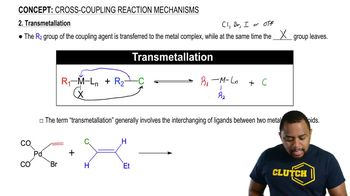
Transmetalation
Stage where a carbon group from the coupling agent replaces the halide on the metal complex, exchanging ligands.
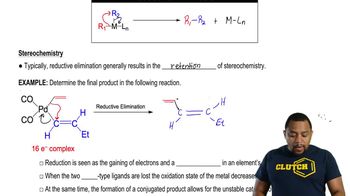
Reductive Elimination
Final mechanistic step where two carbon groups bond, regenerating the catalyst and forming the main product.
Conjugated Product
Molecule with alternating single and double bonds, resulting in enhanced stability and often a reaction's driving force.
Catalytic Cycle
Sequence of steps involving catalyst regeneration, enabling repeated product formation without catalyst consumption.
Byproduct
Substance formed alongside the desired product, typically discarded and not central to the reaction's purpose.
Aryl Halide
Compound featuring a benzene ring bonded to a halogen, commonly used as a reactant in coupling reactions.
Vinyl Halide
Molecule with a halogen attached to an alkene carbon, serving as a reactive partner in cross coupling.