What are the two main driving forces behind cross coupling reactions?
The two main driving forces are the formation of highly conjugated, stable products and the transition metal catalyst's tendency to achieve the 18 or 16 electron rule.
What is the general setup for a cross coupling reaction?
It involves a carbon halide (R1-X) and a coupling agent (R2), combined using a transition metal catalyst (M) with ligands (L), to form a new product (R1-R2) and byproducts (CNX).
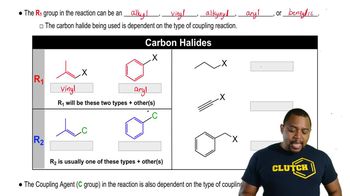
What types of groups can R1 represent in cross coupling reactions?
R1 can be an alkyl, vinyl, aryl, or benzylic halide, with vinyl and aryl halides being most common due to their ability to form conjugated products.
Why are alkyl halides less commonly used as R1 in cross coupling reactions?
Alkyl halides lack pi bonds and do not lead to more conjugated products, making them less favorable for these reactions.
What is the typical role of R2 in cross coupling reactions?
R2 is usually a vinyl or aryl group, serving as the coupling agent to form a more conjugated product with R1.
What are the three main mechanistic steps in a cross coupling reaction?
The three main steps are oxidative addition, transmetalation, and reductive elimination.
What happens during the oxidative addition step?
The transition metal inserts into the R1-X bond, increasing its electron count by 2 and forming new bonds with both R1 and X.
How does the electron count of the transition metal change during oxidative addition?
The electron count increases by 2 as the metal forms bonds with both R1 and X.
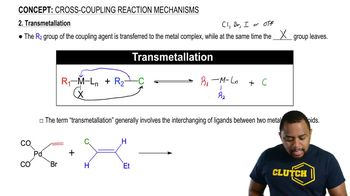
What occurs during the transmetalation step?
R2 from the coupling agent attaches to the transition metal complex while the X group leaves, often as a byproduct with the C group.
Which groups commonly serve as the X group in cross coupling reactions?
X is typically a good leaving group such as chlorine, bromine, iodine, or a triflate.
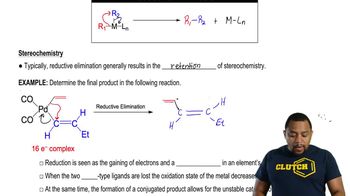
What is the purpose of the reductive elimination step?
Reductive elimination forms a new bond between R1 and R2, releasing them from the metal and regenerating the catalyst.
How does reductive elimination affect the electron count of the transition metal?
It decreases the electron count, moving the metal away from the 18 or 16 electron rule and regenerating the catalyst.
What is the significance of catalyst regeneration in the cross coupling catalytic cycle?
Regeneration allows the catalyst to participate in another reaction cycle, maintaining the efficiency of the process.
How does the stereochemistry of alkenes typically change during reductive elimination?
Reductive elimination generally retains the stereochemistry (E or Z configuration) of the alkene.
Why is understanding the roles of R1, R2, and the transition metal catalyst important in cross coupling reactions?
It is crucial for predicting reaction outcomes and mastering the mechanisms of various cross coupling setups.