Back

Cumulative Electrocyclic Problems definitions

Control buttons has been changed to "navigation" mode.
1/15
  • Electrocyclic Reaction

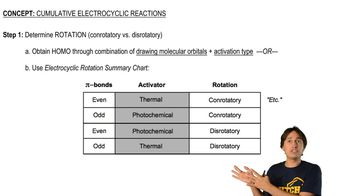
    A process where a pi system undergoes ring closure or opening, with stereochemistry determined by rotation mode and activation type.
  • Thermal Activation

    A condition where heat is used to initiate a reaction, influencing the rotation mode in electrocyclic processes.
  • Photochemical Activation

    A condition where light energy triggers a reaction, altering the stereochemical outcome compared to heat.
  • Conrotatory Rotation

    A mode where terminal groups rotate in the same direction, leading to specific stereochemical products.
  • Disrotatory Rotation

    A mode where terminal groups rotate in opposite directions, resulting in distinct stereochemical outcomes.
  • Pi Bond

    A type of covalent bond formed by sideways overlap of p orbitals, crucial in determining reaction pathways.
  • Stereochemistry

    The spatial arrangement of atoms in molecules, especially as it relates to the outcome of ring closures or openings.
  • Cis Product

    A stereochemical result where substituents are on the same side of a ring or double bond after reaction.
  • Trans Product

    A stereochemical result where substituents are on opposite sides of a ring or double bond after reaction.
  • Molecular Orbital

    A region in a molecule where electrons are likely found, used to predict reaction outcomes by manual drawing.
  • HOMO

    The highest energy molecular orbital containing electrons, key for predicting rotation in electrocyclic reactions.
  • Mnemonic

    A memory aid, such as 'etcetera' or 'if it's the same, dis is sis,' to simplify prediction of reaction outcomes.
  • Cheat Sheet

    A summary chart or tool designed to quickly determine rotation and stereochemistry without full orbital analysis.
  • Polyene

    A molecule containing multiple pi bonds, whose number affects the rotation mode in electrocyclic reactions.
  • Same Pi Bonds

    A situation where both pi bonds are either cis or trans, influencing whether the product is cis or trans.