Back

Cumulative Electrocyclic Problems quiz

Control buttons has been changed to "navigation" mode.
1/15
  • What is the first step in analyzing an electrocyclic reaction's stereochemistry?

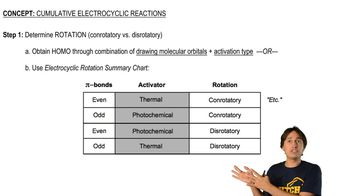
    The first step is to determine the type of rotation: conrotatory or disrotatory.
  • How can you manually determine the rotation in an electrocyclic reaction?

    You can manually determine the rotation by drawing the molecular orbitals and considering the activation type (thermal or photochemical).
  • What does the 'etcetera' mnemonic help you remember in electrocyclic reactions?

    It helps you remember that an even number of pi bonds with thermal activation leads to conrotatory rotation.
  • What happens to the rotation if you change one variable from the 'etcetera' base condition?

    Changing one variable (either number of pi bonds or activation type) switches the rotation to disrotatory.
  • If both the number of pi bonds and activation type are changed from the base condition, what is the resulting rotation?

    Changing both variables reverts the rotation back to conrotatory.
  • What is the second step after determining the rotation in an electrocyclic reaction?

    The second step is to determine the stereochemistry (cis or trans) of the product.
  • How does the 'if it's the same, dis is cis' mnemonic help with stereochemistry?

    It reminds you that if the pi bonds are the same (both cis or both trans) and the reaction is disrotatory, the product will be cis.
  • What does it mean for pi bonds to be 'same' or 'different' in this context?

    'Same' means both pi bonds are either cis or both are trans; 'different' means one is cis and one is trans.
  • What is the outcome if the pi bonds are different and the reaction is disrotatory?

    If the pi bonds are different and the reaction is disrotatory, the product will be trans.
  • What is the outcome if the pi bonds are the same and the reaction is conrotatory?

    If the pi bonds are the same and the reaction is conrotatory, the product will be trans.
  • What is the outcome if the pi bonds are different and the reaction is conrotatory?

    If the pi bonds are different and the reaction is conrotatory, the product will be cis.
  • Is it acceptable to always use the manual method for determining electrocyclic reaction outcomes?

    Yes, it is always acceptable to use the manual method of drawing molecular orbitals and analyzing the reaction.
  • Why might you choose to use the cheat sheet or mnemonics for these reactions?

    You might use them for quicker analysis, especially if you expect to encounter many electrocyclic reactions.
  • What should you consider when deciding whether to use the shortcut methods or the manual method?

    Consider how much your course focuses on these reactions and your comfort with the material.
  • What is the main advantage of using the summary charts or mnemonics for electrocyclic reactions?

    They allow you to predict rotation and stereochemistry outcomes more quickly without drawing molecular orbitals each time.