Skip to main content
Organic Chemistry
My Course
Learn
Exam Prep
AI Tutor
Study Guides
Textbook Solutions
Flashcards
Explore
Try the app
My Course
Learn
Exam Prep
AI Tutor
Study Guides
Textbook Solutions
Flashcards
Explore
Try the app
Back
Dehydrohalogenation definitions
You can tap to flip the card.
Dehydrohalogenation
You can tap to flip the card.
👆
Dehydrohalogenation
A reaction where a hydrogen and a halogen are removed from adjacent carbons, forming a double bond via an E2 mechanism.
Track progress
Control buttons has been changed to "navigation" mode.
1/13
Related flashcards
Related practice
Recommended videos
Dehydrohalogenation quiz #1
Dehydrohalogenation
10 Terms
Dehydrohalogenation
9. Alkenes and Alkynes
2 problems
Topic
Johnny
Double Elimination
9. Alkenes and Alkynes
2 problems
Topic
Johnny
9. Alkenes and Alkynes - Part 1 of 2
5 topics
11 problems
Chapter
Ernest
9. Alkenes and Alkynes - Part 2 of 2
5 topics
11 problems
Chapter
Johnny
03:02
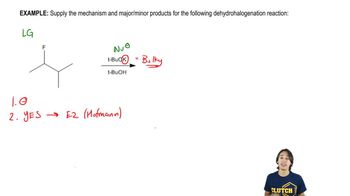
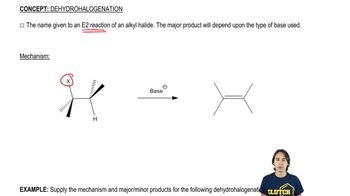
The dehydrohalogenation mechanism.
5349
views
31
rank
17
comments
04:35
Dehydrohalogenation mechanism and products
4183
views
51
rank
38
comments
Terms in this set (13)
Hide definitions
Dehydrohalogenation
A reaction where a hydrogen and a halogen are removed from adjacent carbons, forming a double bond via an E2 mechanism.
E2 Mechanism
A concerted elimination process where a base removes a beta hydrogen as a leaving group departs, forming a pi bond.
Alkyl Halide
A molecule containing a carbon chain bonded to a halogen, serving as the substrate for elimination.
Beta Hydrogen
A hydrogen atom attached to the carbon adjacent to the one bearing the leaving group, targeted during elimination.
Base
A species that abstracts a proton from the beta position, initiating the elimination process.
Zaitsev Product
The more substituted alkene formed preferentially when a small, strong base is used in elimination.
Hofmann Product
The less substituted alkene formed when a bulky base is used, due to steric hindrance.
Antiperiplanar Geometry
A spatial arrangement where the beta hydrogen and leaving group are on opposite sides, favoring elimination.
Leaving Group
An atom or group, often a halide, that departs with a pair of electrons during the reaction.
Conjugate Acid
The species formed when the base gains a proton during the elimination process.
Double Bond
A pi bond formed between two carbons as a result of the elimination of a hydrogen and a halogen.
Newman Projection
A visual representation used to assess the spatial orientation of substituents during elimination.
Substitution
The degree to which carbons bonded to the reactive center are replaced by other carbon groups, influencing reactivity.
 BackBack

 03:02
03:02