Back

Disaccharide definitions

Control buttons has been changed to "navigation" mode.
1/13
  • Disaccharide

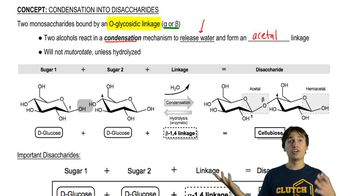
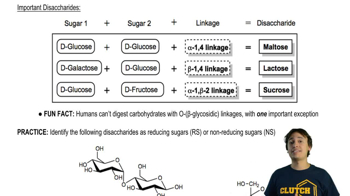
    A molecule composed of two monosaccharides joined by an O glycosidic bond, formed through condensation with water release.
  • Monosaccharide

    A simple sugar unit that serves as the building block for larger carbohydrates like disaccharides.
  • O Glycosidic Bond

    A covalent linkage between two sugar molecules involving an oxygen atom, typically at the anomeric position.
  • Condensation Reaction

    A process where two molecules combine to form a larger molecule, releasing a water molecule as a byproduct.
  • Acetal

    A functional group where a carbon is bonded to two OR groups, often formed at the linkage site in disaccharides.
  • Hemiacetal

    A functional group with a carbon attached to one OR and one OH group, often present at the non-linkage anomeric carbon.
  • Beta 1,4 Linkage

    A specific glycosidic bond connecting the first carbon of one sugar to the fourth carbon of another, with beta stereochemistry.
  • Alpha Linkage

    A glycosidic bond where the oxygen bridge is oriented opposite to the reference carbon's substituent in the sugar ring.
  • Mutarotation

    A process where the configuration at the anomeric carbon of a sugar changes, which does not occur in disaccharides.
  • Epimerization

    A change in configuration at a single stereocenter in a sugar, a process not observed in stable disaccharides.
  • Anomeric Position

    The carbon in a sugar ring that was the carbonyl carbon in the open-chain form, crucial for glycosidic bond formation.
  • Cellobiose

    A disaccharide formed from two D-glucose units connected by a beta 1,4 glycosidic bond.
  • Stereodescriptor Carbon

    A reference carbon in a sugar ring used to determine the alpha or beta configuration of glycosidic linkages.