Back

Disulfide Bonds definitions

Control buttons has been changed to "navigation" mode.
1/14
  • Disulfide Bond

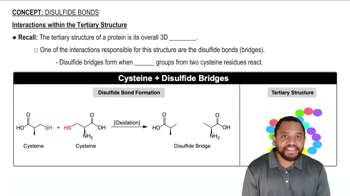
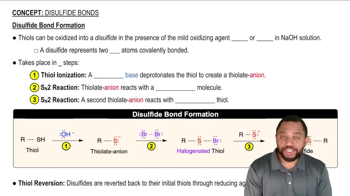
    A covalent sulfur-sulfur linkage formed by oxidation of two thiol groups, crucial for stabilizing protein tertiary structure.
  • Thiol

    A functional group containing a sulfur atom bonded to hydrogen, serving as the precursor for disulfide formation.
  • Thiolate Anion

    A negatively charged sulfur species generated by deprotonation of a thiol, acting as a nucleophile in disulfide synthesis.
  • Oxidation

    A chemical process involving the loss of hydrogen from thiols, enabling the formation of sulfur-sulfur bonds.
  • Reduction

    A reaction that converts disulfide bonds back to thiols, typically using agents like hydrochloric acid and zinc.
  • SN2 Mechanism

    A bimolecular nucleophilic substitution pathway where a nucleophile attacks a substrate, displacing a leaving group in one step.
  • Dihalide

    A molecule containing two halogen atoms, serving as an electrophilic partner in disulfide bond formation.
  • Halogenated Thiol

    An intermediate species formed when a thiolate anion reacts with a dihalide, containing both sulfur and halogen atoms.
  • Cysteine

    An amino acid with a thiol side chain, whose residues participate in forming disulfide bridges within proteins.
  • Tertiary Structure

    The overall three-dimensional folding of a protein, stabilized by interactions such as disulfide bridges.
  • Peptide Chain

    A linear sequence of amino acids in a protein, whose folding is influenced by covalent and non-covalent interactions.
  • Disulfide Bridge

    A synonym for disulfide bond, emphasizing its role in linking different parts of a protein chain.
  • Leaving Group

    An atom or group, such as bromine, that departs with a pair of electrons during nucleophilic substitution.
  • Mild Oxidizing Agent

    A substance like bromine or iodine in basic solution, facilitating the conversion of thiols to disulfides without harsh conditions.