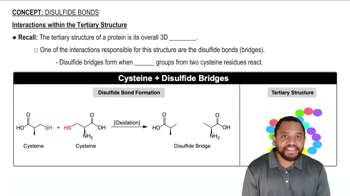
A disulfide bond is a covalent linkage between two sulfur atoms, typically formed from the oxidation of thiols.
Which amino acid forms disulfide bridges in proteins?
Cysteine forms disulfide bridges by reacting through its thiol (–SH) groups.
What is the first step in disulfide bond formation from thiols?
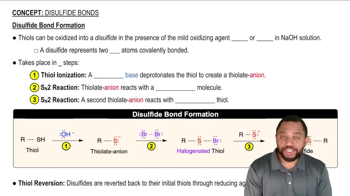
The first step is thiol ionization, where a strong base deprotonates the thiol to create a thiolate anion.
What role does sodium hydroxide play in disulfide bond formation?
Sodium hydroxide acts as a strong base to deprotonate the thiol, forming a thiolate anion.
What type of reaction occurs in the second step of disulfide bond formation?
An SN2 reaction occurs, where the thiolate anion attacks a dihalide molecule, forming a halogenated thiol.
How is the final disulfide bond formed in the third step?
A second thiolate anion performs an SN2 attack on the halogenated thiol, resulting in the disulfide bond.
What is the function of bromine or iodine in disulfide bond formation?
Bromine or iodine acts as a mild oxidizing agent in the presence of sodium hydroxide to facilitate thiol oxidation.
How can a disulfide bond be reverted back to two thiols?
Disulfide bonds can be reduced back to thiols using hydrochloric acid and zinc as reducing agents.
What is the significance of disulfide bonds in protein structure?
Disulfide bonds stabilize the tertiary structure of proteins by linking peptide chains and maintaining their three-dimensional shape.
What is meant by the tertiary structure of a protein?
The tertiary structure refers to the overall three-dimensional shape of a protein, resulting from bending and twisting of the peptide chain.
What is another name for disulfide bonds in proteins?
Disulfide bonds are also called disulfide bridges.
What happens to the hydrogen atoms during disulfide bond formation between cysteine residues?
Hydrogen atoms are lost during oxidation, allowing the sulfur atoms from two cysteine residues to bond together.
Why are disulfide bonds considered reversible?
Disulfide bonds can be broken and reverted to thiols through reduction, making them reversible.
What type of covalent interaction is responsible for stabilizing protein tertiary structure?
Disulfide bridges, formed between cysteine residues, are a key covalent interaction stabilizing protein tertiary structure.
What is the importance of understanding disulfide bond formation and reversion in biochemistry?
It is crucial for understanding protein folding, stability, and function, as well as the role of covalent bonding and redox reactions in biochemical systems.