Skip to main content
Organic Chemistry
My Course
Learn
Exam Prep
AI Tutor
Study Guides
Textbook Solutions
Flashcards
Explore
Try the app
My Course
Learn
Exam Prep
AI Tutor
Study Guides
Textbook Solutions
Flashcards
Explore
Try the app
Back
DNA Double Helix definitions
You can tap to flip the card.
Double Helix
You can tap to flip the card.
👆
Double Helix
A twisted ladder-like structure with two antiparallel strands, forming the three-dimensional shape of DNA.
Track progress
Control buttons has been changed to "navigation" mode.
1/15
Related flashcards
Related practice
Recommended videos
DNA Double Helix quiz
DNA Double Helix
17 Terms
DNA Double Helix
34. Nucleic Acids
5 problems
Topic
Base Pairing
34. Nucleic Acids
5 problems
Topic
34. Nucleic Acids - Part 1 of 2
4 topics
12 problems
Chapter
34. Nucleic Acids - Part 2 of 2
3 topics
9 problems
Chapter
Guided course
2:51
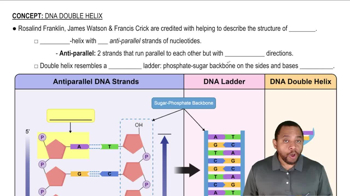
DNA Double Helix Concept 2
767
views
Guided course
1:49
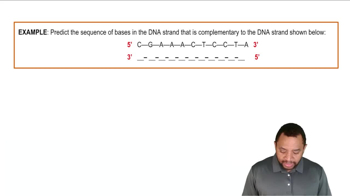
DNA Double Helix Example 1
752
views
Guided course
3:27
DNA Double Helix Concept 1
801
views
Terms in this set (15)
Hide definitions
Double Helix
A twisted ladder-like structure with two antiparallel strands, forming the three-dimensional shape of DNA.
Antiparallel Strands
Two nucleotide chains running in opposite directions, enabling complementary base pairing in DNA.
Nucleotide
A building block composed of a phosphate group, a pentose sugar, and a nitrogenous base.
Phosphate Group
A component attached to the 5' carbon of the sugar, contributing to the backbone of DNA.
Pentose Sugar
A five-carbon ring structure forming part of the DNA backbone, connecting to both phosphate and base.
Nitrogenous Base
An interior molecule in DNA that pairs via hydrogen bonds, stabilizing the double helix.
Phosphodiester Bond
A linkage joining nucleotides between the 3' and 5' carbons, forming the DNA backbone.
Sugar-Phosphate Backbone
The exterior framework of DNA, consisting of alternating sugars and phosphates.
Hydrogen Bond
A weak interaction stabilizing base pairs between DNA strands, crucial for double helix integrity.
Complementary Base Pairing
Specific matching of bases across strands, ensuring accurate genetic information transfer.
Major Groove
The wider, deeper groove on the DNA helix exterior, often targeted by proteins for binding.
Minor Groove
The narrower, shallower groove on the DNA helix, also accessible to certain proteins.
Primary Structure
The linear sequence of nucleotides in a DNA strand, linked by phosphodiester bonds.
Base Pair
A set of two nitrogenous bases from opposite strands, connected by hydrogen bonds.
Turn
A complete 360-degree twist of the DNA helix, typically containing 10 base pairs and measuring 34 angstroms.
 BackBack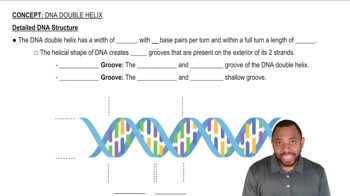
 2:51
2:51