Back

Drawing Newman Projections definitions

Control buttons has been changed to "navigation" mode.
1/15
  • Bond-line Structure

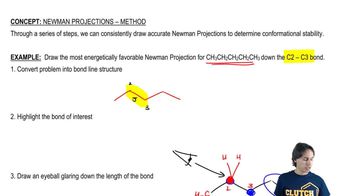
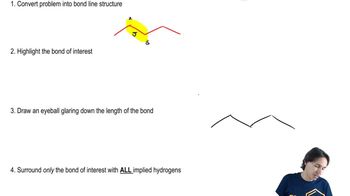
    A simplified drawing showing only carbon skeletons and heteroatoms, omitting most hydrogens for clarity.
  • Condensed Structure

    A compact molecular representation listing atoms and their connectivity in a linear format.
  • Pentane

    A five-carbon straight-chain alkane often used as an example for conformational analysis.
  • Bond of Interest

    A specific sigma connection between two carbons chosen for rotational analysis in conformational studies.
  • Sigma Bond

    A single covalent linkage allowing free rotation, central to conformational isomerism.
  • Implied Hydrogen

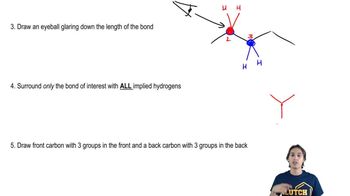
    A hydrogen atom not explicitly drawn but understood to be attached to a carbon in skeletal formulas.
  • Newman Projection

    A visual tool depicting the spatial arrangement of groups around a bond by viewing directly along its axis.
  • Front Carbon

    The carbon atom closest to the viewer in a Newman projection, represented as a dot with three attached groups.
  • Back Carbon

    The carbon atom farther from the viewer in a Newman projection, shown as a circle with three attached groups.
  • Methyl Group

    A one-carbon substituent, often abbreviated as 'Me', commonly attached to carbons in organic molecules.
  • Ethyl Group

    A two-carbon substituent, abbreviated as 'Et', frequently encountered in conformational analysis.
  • Anti Conformation

    A spatial arrangement where the largest groups on adjacent carbons are 180° apart, maximizing stability.
  • Dihedral Angle

    The angle between two groups on adjacent carbons, crucial for distinguishing conformations like anti or gauche.
  • Eclipsed Conformation

    A less stable arrangement where groups on adjacent carbons align, increasing torsional strain.
  • Gauche Conformation

    A conformation where large groups on adjacent carbons are 60° apart, resulting in moderate steric strain.