Back

E1 Reaction definitions

Control buttons has been changed to "navigation" mode.
1/15
  • E1 Mechanism

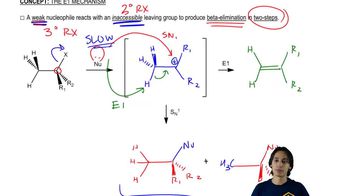
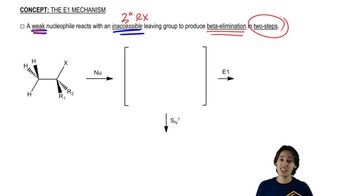
    A two-step elimination process where a weak nucleophile and a tertiary leaving group yield a carbocation intermediate before forming a double bond.
  • SN1 Mechanism

    A substitution pathway involving carbocation formation, followed by nucleophilic attack, often producing racemic mixtures due to chiral centers.
  • Carbocation

    A positively charged intermediate formed after the leaving group departs, crucial for both E1 and SN1 reactions.
  • Leaving Group

    An atom or group that departs from the substrate, enabling carbocation formation and dictating reaction rate.
  • Nucleophile

    A species with lone pairs that can act as a base or attacker, but in E1, typically waits for carbocation formation.
  • Beta Proton

    A hydrogen atom on a carbon adjacent to the carbocation, abstracted during the elimination step to form a double bond.
  • Double Bond

    A feature in the elimination product resulting from the removal of a beta proton and electrons filling the carbocation.
  • Tertiary Alkyl Halide

    A substrate with three alkyl groups attached to the carbon bearing the leaving group, favoring carbocation stability.
  • Racemization

    The process leading to equal amounts of enantiomers, common in SN1 due to attack on planar carbocations.
  • Unimolecular Kinetics

    A rate law dependent only on the substrate concentration, not on nucleophile or base concentration.
  • Mixture of Products

    A common outcome in E1 and SN1, where multiple substitution and elimination products are formed, complicating synthesis.
  • Stereochemistry

    The spatial arrangement of atoms, which is not a concern in E1 due to the absence of geometric requirements.
  • Anticoplanar Geometry

    A spatial requirement for E2 reactions, but not necessary in E1 since the leaving group has already departed.
  • Intermediate

    A species, such as a carbocation, formed between steps in a reaction mechanism, distinct from a transition state.
  • Synthesis

    The process of constructing target molecules, often hindered by E1 and SN1 due to the formation of multiple similar products.