Organic Chemistry
My Course
Learn
Exam Prep
AI Tutor
Study Guides
Textbook Solutions
Flashcards
Explore
Try the app
My Course
Learn
Exam Prep
AI Tutor
Study Guides
Textbook Solutions
Flashcards
Explore
Try the app
Back
E2 - Anti-Coplanar Requirement definitions
You can tap to flip the card.
E2 Mechanism
You can tap to flip the card.
👆
E2 Mechanism
A one-step elimination process requiring a specific spatial arrangement for effective pi bond formation.
Track progress
Control buttons has been changed to "navigation" mode.
1/13
Related flashcards
Related practice
Recommended videos
E2 - Anti-Coplanar Requirement quiz
E2 - Anti-Coplanar Requirement
15 Terms
E2 - Anti-Coplanar Requirement
8. Elimination Reactions
7 problems
Topic

Johnny
E2 - Cumulative Practice
8. Elimination Reactions
1 problem
Topic

Ernest
8. Elimination Reactions - Part 1 of 2
5 topics
11 problems
Chapter
Johnny
8. Elimination Reactions - Part 2 of 2
4 topics
10 problems
Chapter
Ernest
Guided course
03:19
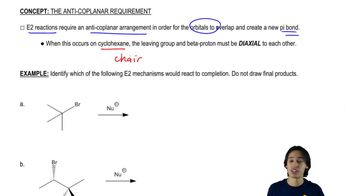
The Anti-Coplanar Requirement
4829
views
41
rank
5
comments
Guided course
03:39
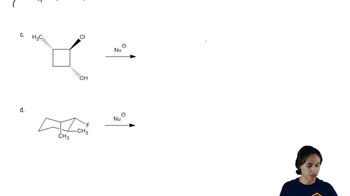
Identify the completion of E2 mechanisms
3630
views
32
rank
24
comments
Guided course
01:09
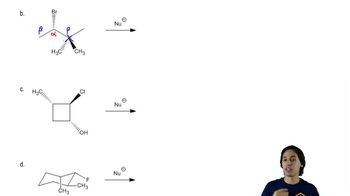
Identify the completion of E2 mechanisms
3829
views
31
rank
17
comments
Terms in this set (13)
Hide definitions
E2 Mechanism
A one-step elimination process requiring a specific spatial arrangement for effective pi bond formation.
Anticoplanar Arrangement
A spatial orientation where two groups are on opposite sides of the same plane, enabling proper orbital overlap.
Leaving Group
An atom or group that departs with a pair of electrons during a reaction, facilitating bond changes.
Beta Hydrogen
A hydrogen atom attached to the carbon adjacent to the one bearing the leaving group, crucial for elimination.
Pi Bond
A bond formed by sideways overlap of p orbitals, resulting in a region of electron density above and below the bond axis.
Cyclohexane
A six-membered carbon ring often adopting a chair conformation, affecting spatial group arrangements.
Chair Conformation
A three-dimensional shape of cyclohexane minimizing strain, with alternating axial and equatorial positions.
Diaxial Requirement
A condition in cyclohexane where two substituents must occupy adjacent axial positions for elimination.
Axial Position
A location in the chair form of cyclohexane where a substituent points perpendicular to the ring plane.
Equatorial Position
A location in the chair form of cyclohexane where a substituent extends outward, roughly parallel to the ring.
Alkyl Halide
A compound containing a halogen atom bonded to an sp3-hybridized carbon, serving as a substrate in elimination.
Nucleophile
A species with a lone pair or pi electrons that seeks positive centers, often initiating elimination.
Gauche Arrangement
A spatial relationship where two groups are 60 degrees apart, not optimal for E2 elimination.