Back

E2 Mechanism definitions

Control buttons has been changed to "navigation" mode.
1/15
  • E2 Mechanism

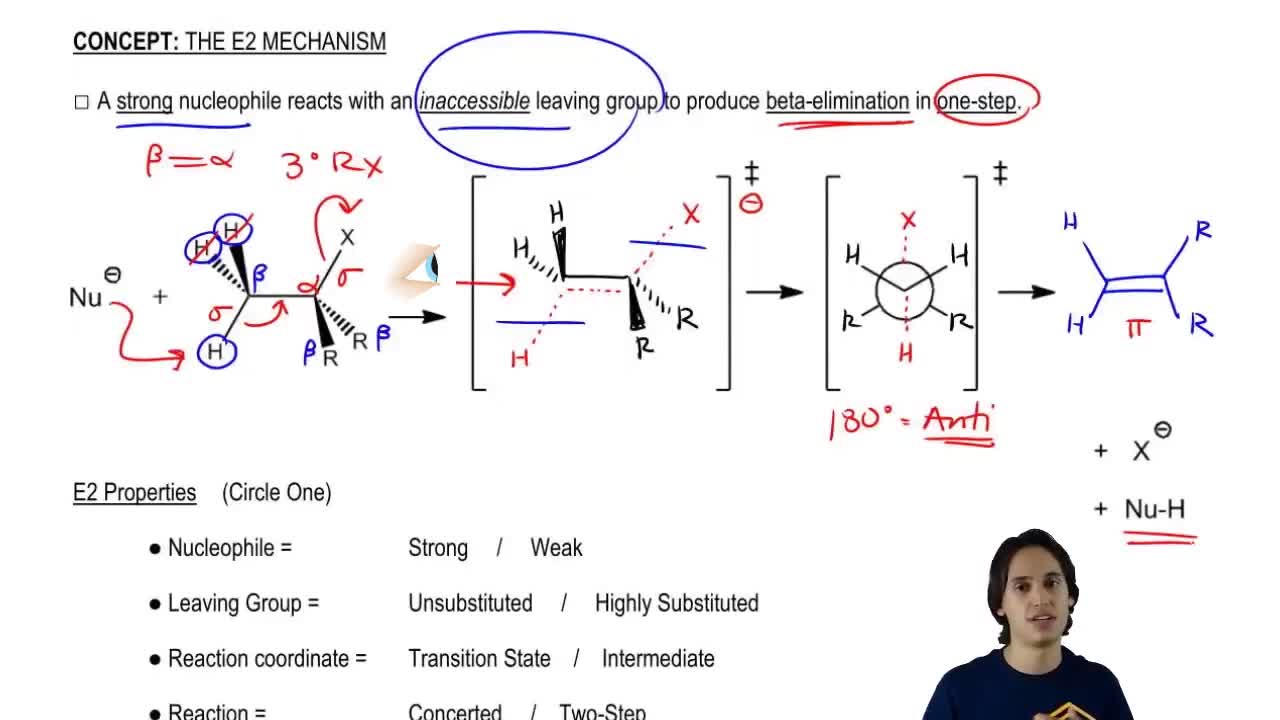
    A concerted, one-step elimination where a strong nucleophile removes a beta hydrogen, forming a double bond as the leaving group departs.
  • Nucleophile

    A negatively charged or electron-rich species that initiates the reaction by seeking a positive center or proton.
  • Leaving Group

    An atom or group that detaches from the substrate, stabilizing itself after bond cleavage during the reaction.
  • Beta Hydrogen

    A hydrogen atom bonded to a carbon adjacent to the one bearing the leaving group, targeted for removal in elimination.
  • Alpha Carbon

    The carbon atom directly attached to the leaving group, central to bond changes during the reaction.
  • Beta Carbon

    A carbon atom directly bonded to the alpha carbon, often bearing the hydrogen removed in elimination.
  • Transition State

    A fleeting structure where bond-breaking and bond-making occur simultaneously, with partial bonds present.
  • Antiperiplanar Geometry

    A spatial arrangement where the beta hydrogen and leaving group are 180 degrees apart, required for reaction.
  • Concerted Process

    A reaction pathway where all bond changes occur in a single, continuous step without intermediates.
  • Bimolecular Reaction

    A process whose rate depends on the concentrations of both the nucleophile and the substrate.
  • Steric Hindrance

    Physical crowding around a reactive site, often preventing backside attack and favoring elimination.
  • Alkyl Halide

    A molecule containing a halogen atom bonded to an sp3-hybridized carbon, serving as the substrate.
  • Pi Bond

    A bond formed by sideways overlap of p orbitals, resulting from the elimination of two sigma bonds.
  • Sigma Bond

    A single covalent bond formed by head-on orbital overlap, broken during elimination to form a double bond.
  • Newman Projection

    A visual representation used to analyze spatial relationships around a single bond, crucial for stereochemistry.