Back

EAS:Synergistic and Competitive Groups definitions

Control buttons has been changed to "navigation" mode.
1/14
  • Polysubstituted Benzene

    A benzene ring containing two or more substituents, requiring analysis of both steric and directing effects for further reactions.
  • Steric Hindrance

    A spatial effect where bulky groups block certain positions on a benzene ring, making them less reactive or unreactive.
  • Directing Effects

    Influences from existing groups on a benzene ring that determine the preferred positions for new substituents during reactions.
  • Synergistic Groups

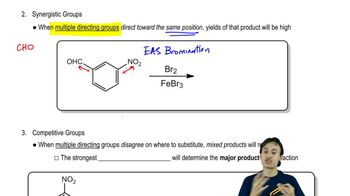
    Multiple substituents on a benzene ring that direct new additions to the same position, resulting in high product yield.
  • Competitive Groups

    Substituents on a benzene ring that direct new additions to different positions, causing mixed products and lower yields.
  • Meta Director

    A substituent that guides incoming groups to the meta position relative to itself on a benzene ring during substitution.
  • Activity Chart

    A ranking of substituents based on their activating or deactivating effects, used to predict major products in competitive scenarios.
  • Major Product

    The compound formed in the greatest amount during a reaction, determined by the most activating or least deactivating group present.
  • Minor Product

    A compound formed in smaller amounts during a reaction, typically due to less favorable directing effects.
  • Electron Withdrawing Group

    A substituent that pulls electron density away from the benzene ring, often leading to deactivation and meta direction.
  • Aldehyde

    A moderate electron withdrawing group on benzene, represented as CHO, influencing substitution to the meta position.
  • Nitro Group

    A strong electron withdrawing group (NO2) that is highly deactivating and directs new substituents to the meta position.
  • Bromination

    An electrophilic aromatic substitution where bromine is added to a benzene ring, often used to illustrate directing effects.
  • Yield

    The amount of product obtained from a reaction, influenced by whether directing effects are synergistic or competitive.