Back

EAS:Sequence Groups quiz

Control buttons has been changed to "navigation" mode.
1/15
  • What is a sequence group in the context of benzene reactions?

    A sequence group is a substituent that can change its directing effects through a chemical transformation, allowing for control over the position of subsequent substitutions on the benzene ring.
  • Why are sequence groups important in aromatic synthesis?

    Sequence groups are important because they allow chemists to control where new substituents are added to the benzene ring by altering directing effects during synthesis.
  • What type of director is a nitro group on a benzene ring?

    A nitro group is a strong meta director on a benzene ring.
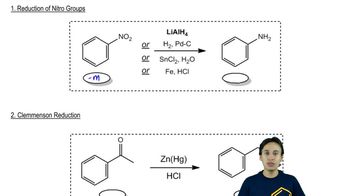
  • What does the reduction of a nitro group produce, and how does this affect directing effects?

    Reduction of a nitro group produces an amino group (aniline), which is a strong ortho/para director.
  • Name two reducing agents that can convert a nitro group to an amino group.

    Examples include catalytic hydrogenation and iron with HCl.
  • What is the directing effect of an acyl group on a benzene ring?

    An acyl group is a meta director on a benzene ring.
  • What reaction converts an acyl group to an alkyl group, and how does this change the directing effect?

    The Clemmensen reduction converts an acyl group to an alkyl group, changing the directing effect from meta to ortho/para.
  • What is the directing effect of an alkyl group on a benzene ring?

    An alkyl group is an ortho/para director.
  • How does side chain oxidation with potassium permanganate affect the directing group on a benzene ring?

    Side chain oxidation converts an alkyl group (ortho/para director) into a carboxylic acid group (meta director).
  • What is the product of oxidizing a benzene ring with a side chain using potassium permanganate?

    The product is benzoic acid, which is a strong meta director.
  • Why must you consider the sequence of adding reagents when using sequence groups?

    Because the order determines the position of new substituents due to changes in directing effects after each transformation.
  • What exception exists for side chain oxidation on a benzene ring?

    Side chain oxidation will not occur if there are no hydrogen atoms on the benzylic position.
  • If you want a meta substituent on a benzene ring, should you react before or after reducing a nitro group?

    You should react before reducing the nitro group, while it is still a meta director.
  • If you want an ortho or para substituent, should you react before or after reducing a nitro group?

    You should react after reducing the nitro group to an amino group, which is an ortho/para director.
  • What is the main synthetic advantage of using sequence groups in EAS reactions?

    Sequence groups allow for targeted substitution by changing the directing effects, enabling the synthesis of more complex aromatic compounds.