Organic Chemistry
My Course
Learn
Exam Prep
AI Tutor
Study Guides
Textbook Solutions
Flashcards
Explore
Try the app
My Course
Learn
Exam Prep
AI Tutor
Study Guides
Textbook Solutions
Flashcards
Explore
Try the app
Back
Eglinton Reaction definitions
You can tap to flip the card.
Eglinton Reaction
You can tap to flip the card.
👆
Eglinton Reaction
A copper-catalyzed process coupling two identical terminal alkynes to yield a conjugated bi-alkynyl compound via radical intermediates.
Track progress
Control buttons has been changed to "navigation" mode.
1/14
Related flashcards
Related practice
Recommended videos
Eglinton Reaction quiz
Eglinton Reaction
15 Terms
27. Transition Metals
6 topics
14 problems
Chapter
Johnny
Guided course
04:16
Eglinton Reaction
783
views
Guided course
02:49
Eglinton Reaction
799
views
Guided course
02:05
Eglinton Reaction Example 1
798
views
Terms in this set (14)
Hide definitions
Eglinton Reaction
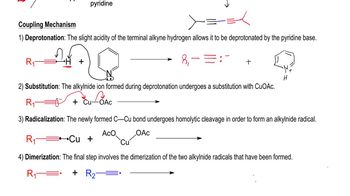
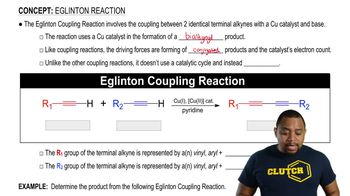
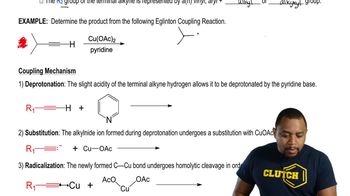
A copper-catalyzed process coupling two identical terminal alkynes to yield a conjugated bi-alkynyl compound via radical intermediates.
Terminal Alkyne
A molecule featuring a carbon-carbon triple bond at the end of its chain, with a hydrogen directly attached to the triple-bonded carbon.
Copper Catalyst
A transition metal species, often in +1 or +2 oxidation states, facilitating bond formation without being consumed in the reaction.
Pyridine
A nitrogen-containing aromatic base, structurally similar to benzene, used to deprotonate terminal alkynes.
Conjugation
A system where alternating single and multiple bonds allow electron delocalization, increasing molecular stability.
Radical Intermediate
A highly reactive species with an unpaired electron, formed during homolytic bond cleavage in the reaction mechanism.
Deprotonation
The removal of a hydrogen ion from a molecule, often facilitated by a base, generating a negatively charged species.
Alkynide Ion
A negatively charged carbon species formed after deprotonation of a terminal alkyne, capable of further reaction.
Copper-Alkynide Complex
A coordination compound where a copper ion is bonded to an alkynide ion, serving as a key intermediate.
Homolytic Cleavage
A bond-breaking process where each atom retains one electron, producing radicals instead of ions.
Dimerization
A process where two identical radicals combine to form a single, more stable molecule.
Bi-alkynyl Product
A molecule containing two conjugated alkyne units, resulting from the coupling of two terminal alkynes.
Acetate Ion
A negatively charged ion derived from acetic acid, often acting as a leaving group in substitution steps.
18 Electron Rule
A guideline stating that transition metal complexes are most stable when their valence shell contains 18 electrons.