Organic Chemistry
My Course
Learn
Exam Prep
AI Tutor
Study Guides
Textbook Solutions
Flashcards
Explore
Try the app
My Course
Learn
Exam Prep
AI Tutor
Study Guides
Textbook Solutions
Flashcards
Explore
Try the app
Back
Electron Configuration of Elements definitions
You can tap to flip the card.
Electron Configuration
You can tap to flip the card.
👆
Electron Configuration
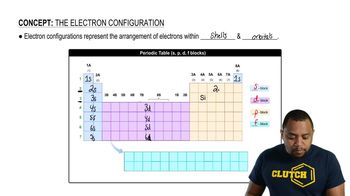
Arrangement of electrons in shells and orbitals, following a specific order based on the periodic table's blocks.
Track progress
Control buttons has been changed to "navigation" mode.
1/15
Related flashcards
Related practice
Recommended videos
Electron Configuration of Elements quiz
Electron Configuration of Elements
10 Terms
27. Transition Metals
6 topics
14 problems
Chapter
Johnny
Guided course
05:03
The Electron Configuration
1147
views
Guided course
01:52
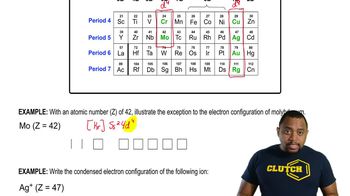
Electron Configuration Exceptions Exercise 1
817
views
1
rank
Guided course
02:54
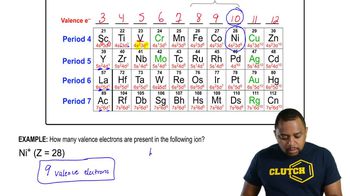
Valence Electrons of Transition Metals Example 1
968
views
1
rank
Terms in this set (15)
Hide definitions
Electron Configuration
Arrangement of electrons in shells and orbitals, following a specific order based on the periodic table's blocks.
Orbital
Region within an atom where electrons are most likely to be found, each with a defined shape and capacity.
S Block
Section of the periodic table containing elements with valence electrons in s orbitals, holding up to 2 electrons per row.
P Block
Section of the periodic table where elements fill p orbitals, each row accommodating up to 6 electrons.
D Block
Region of the periodic table for transition metals, where d orbitals are filled, holding up to 10 electrons per row.
F Block
Area of the periodic table with elements filling f orbitals, each row capable of holding up to 14 electrons.
Condensed Electron Configuration
Shorthand notation for electron arrangement, starting from the last noble gas before the element.
Cation
Positively charged ion formed by the removal of electrons, with electrons lost from the highest shell number first.
Principal Quantum Number
Number indicating the main energy level or shell of an electron, determining its average distance from the nucleus.
Transition Metal
Element found in the d block, characterized by filling s orbitals before d orbitals and often showing electron configuration exceptions.
Valence Electrons
Electrons in the outermost shell involved in bonding; for main group elements, equal to group number; for transition metals, sum of s and d electrons.
Hund's Rule
Guideline stating that electrons occupy degenerate orbitals singly before pairing, maximizing unpaired electrons for stability.
Electron Configuration Exception
Irregular arrangement in some transition metals where s electrons are promoted to d orbitals for half-filled or fully filled stability.
Noble Gas
Element in group 8 of the periodic table, used as a reference point in condensed electron configurations.
Main Group Element
Element in groups 1–8 (A groups), with valence electrons corresponding directly to its group number.