Back

Electron Withdrawing Groups definitions

Control buttons has been changed to "navigation" mode.
1/15
  • Electrophilic Aromatic Substitution

    A reaction where an aromatic ring reacts with an electrophile, often influenced by existing substituents on the ring.
  • Benzene

    A six-membered aromatic ring whose reactivity is altered by substituents affecting its electron density.
  • Electron Donating Group

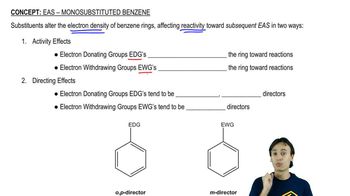
    A substituent that increases electron density in an aromatic ring, enhancing its reactivity toward further substitution.
  • Electron Withdrawing Group

    A substituent that decreases electron density in an aromatic ring, reducing its reactivity toward further substitution.
  • Ortho Position

    A location on a benzene ring adjacent to a substituent, often targeted by certain directing groups during substitution.
  • Para Position

    A location on a benzene ring directly opposite a substituent, commonly favored by specific directing groups.
  • Meta Position

    A location on a benzene ring separated by one carbon from a substituent, typically targeted by electron withdrawing groups.
  • Resonance

    A phenomenon where electrons are delocalized across a molecule, influencing the reactivity and directing effects of substituents.
  • Hyperconjugation

    An effect where alkyl groups stabilize carbocations or aromatic rings by sharing electron density through sigma bonds.
  • Activity Chart

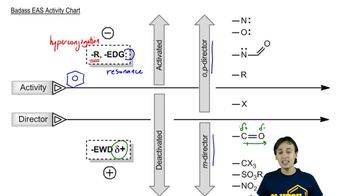
    A reference tool ranking substituents by their activating or deactivating effects and their directing influence on aromatic substitution.
  • Halogen

    A group of elements that weakly deactivate aromatic rings but uniquely direct new substituents to ortho and para positions.
  • Nitro Group

    A strongly deactivating substituent that drastically reduces aromatic ring reactivity and directs new groups to meta positions.
  • Carbonyl

    A functional group with a partial positive charge that moderately deactivates aromatic rings and directs substitution to meta positions.
  • Aniline

    A benzene derivative with an amino group, known for being highly activating due to its lone pair donation.
  • Toluene

    A methyl-substituted benzene that is significantly more reactive than benzene due to the electron-donating effect of the methyl group.