Back

Electron Withdrawing Groups quiz

Control buttons has been changed to "navigation" mode.
1/15
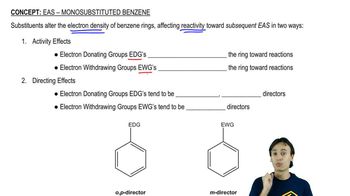
  • What effect do electron withdrawing groups (EWGs) have on the reactivity of a benzene ring in electrophilic aromatic substitution (EAS)?

    EWGs decrease the reactivity of the benzene ring by pulling electron density out, making it less nucleophilic and harder to react in EAS.
  • Where do electron withdrawing groups typically direct new substituents during EAS reactions?

    EWGs direct new substituents to the meta position on the benzene ring.
  • How do electron donating groups (EDGs) affect the electron density of a benzene ring?

    EDGs increase the electron density of the benzene ring, making it more nucleophilic and reactive towards EAS.
  • What is the general trend for the directing effects of EDGs and EWGs in EAS?

    EDGs are ortho/para directors, while EWGs are meta directors.
  • What is the unique behavior of halogens as substituents on a benzene ring in EAS?

    Halogens are weakly deactivating but act as ortho/para directors, which is an exception to the general trend.
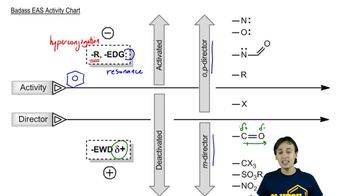
  • What characteristic do most electron withdrawing groups share?

    Most EWGs have a full or partial positive charge, which pulls electrons away from the benzene ring.
  • How does the presence of a carbonyl group next to a benzene ring affect its reactivity?

    A carbonyl group is moderately deactivating due to its partial positive charge, making the ring less reactive in EAS.
  • What is the most strongly deactivating group commonly found on benzene rings?

    The nitro group (NO2) is the most strongly deactivating, making the ring much less reactive in EAS.
  • How does the activity chart categorize substituents relative to unsubstituted benzene?

    Substituents above the activity line are activators (more reactive), while those below are deactivators (less reactive).
  • What is the effect of a positive charge adjacent to a benzene ring?

    A positive charge adjacent to the ring acts as an electron withdrawing group, deactivating the ring.
  • Why are carbonyl-containing groups only moderately deactivating compared to nitro groups?

    Carbonyls have a partial positive charge, while nitro groups have a full positive charge, making nitro groups much more deactivating.
  • What is the general rule for predicting whether a group is electron donating or withdrawing?

    Groups with negative charges or lone pairs are electron donating, while groups with positive charges or carbonyls are electron withdrawing.
  • How does the presence of a lone pair on a heteroatom next to a benzene ring affect its activity?

    A lone pair on a heteroatom (like N or O) next to the ring strongly activates the ring through resonance donation.
  • What is the effect of adding a second EAS reagent to a benzene ring with an EWG already attached?

    The second EAS reaction will be more difficult and will occur at the meta position due to the deactivating effect of the EWG.
  • How do you determine if a substituent is an electron withdrawing group based on its structure?

    If the substituent has a full or partial positive charge, or is a carbonyl, it is likely an electron withdrawing group.