Skip to main content
Organic Chemistry
My Course
Learn
Exam Prep
AI Tutor
Study Guides
Textbook Solutions
Flashcards
Explore
Try the app
My Course
Learn
Exam Prep
AI Tutor
Study Guides
Textbook Solutions
Flashcards
Explore
Try the app
Back
Enthalpy definitions
You can tap to flip the card.
Bond Dissociation Energy
You can tap to flip the card.
👆
Bond Dissociation Energy
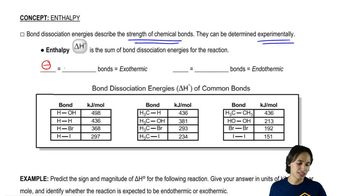
Experimental value indicating the strength needed to break a specific chemical bond, typically measured in kilojoules per mole.
Track progress
Control buttons has been changed to "navigation" mode.
1/15
Related flashcards
Related practice
Recommended videos
Enthalpy quiz
Enthalpy
15 Terms
Enthalpy
6. Thermodynamics and Kinetics
7 problems
Topic
Johnny
Entropy
6. Thermodynamics and Kinetics
6 problems
Topic
Johnny
6. Thermodynamics and Kinetics - Part 1 of 2
4 topics
11 problems
Chapter
Ernest
6. Thermodynamics and Kinetics - Part 2 of 2
4 topics
10 problems
Chapter
Johnny
04:09
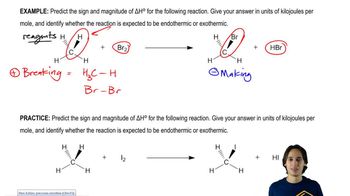
How to calculate enthalpy using bond dissociation energies.
4257
views
26
rank
2
comments
04:38
Calculating Enthalpies
3535
views
28
rank
10
comments
Terms in this set (15)
Hide definitions
Bond Dissociation Energy
Experimental value indicating the strength needed to break a specific chemical bond, typically measured in kilojoules per mole.
Enthalpy
Thermodynamic quantity representing heat change in a reaction, used to determine if a process is exothermic or endothermic.
Exothermic Reaction
Process resulting in a negative energy value, signifying energy release due to bond formation.
Endothermic Reaction
Process resulting in a positive energy value, signifying energy absorption due to bond breaking.
Hydrogen Bond
Type of bond involving hydrogen, noted for its relatively high bond dissociation energy compared to larger atoms.
Methyl Group
Alkyl group derived from methane, often referenced in bond dissociation energy charts for organic reactions.
Delta H
Symbol representing the change in enthalpy during a chemical reaction, indicating heat absorbed or released.
Delta S
Symbol representing the change in entropy, a factor in determining reaction spontaneity alongside enthalpy.
Spontaneity
Characteristic of a reaction determined by enthalpy, entropy, and temperature, not solely by heat change.
Bond Strength
Measure of how much energy is required to break a bond; generally decreases as atomic size increases.
Kilojoule per Mole
Unit used to express bond dissociation energies, quantifying energy per amount of substance.
Bond Formation
Process that releases energy, contributing to a negative enthalpy value in a reaction.
Bond Breaking
Process that requires energy input, contributing to a positive enthalpy value in a reaction.
Elemental Bond
Bond formed between two identical atoms, with strength influenced by atomic size and distance.
Thermal Nature
Classification of a reaction as exothermic or endothermic based on the overall enthalpy change.
 BackBack

 04:09
04:09