Skip to main content
Organic Chemistry
My Course
Learn
Exam Prep
AI Tutor
Study Guides
Textbook Solutions
Flashcards
Explore
Try the app
My Course
Learn
Exam Prep
AI Tutor
Study Guides
Textbook Solutions
Flashcards
Explore
Try the app
Back
Enthalpy quiz
You can tap to flip the card.
What do bond dissociation energies describe in a chemical reaction?
You can tap to flip the card.
👆
What do bond dissociation energies describe in a chemical reaction?
They describe the strength of chemical bonds and are used to determine if a reaction is exothermic or endothermic.
Track progress
Control buttons has been changed to "navigation" mode.
1/15
Related flashcards
Related practice
Recommended videos
Enthalpy definitions
Enthalpy
15 Terms
Enthalpy
6. Thermodynamics and Kinetics
7 problems
Topic
Johnny
Entropy
6. Thermodynamics and Kinetics
6 problems
Topic
Johnny
6. Thermodynamics and Kinetics - Part 1 of 2
4 topics
11 problems
Chapter
Ernest
6. Thermodynamics and Kinetics - Part 2 of 2
4 topics
10 problems
Chapter
Johnny
04:09
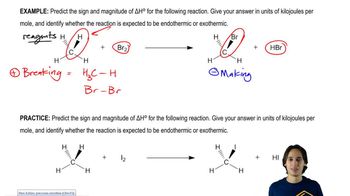
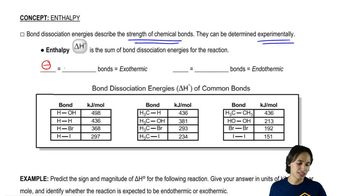
How to calculate enthalpy using bond dissociation energies.
4256
views
26
rank
2
comments
04:38
Calculating Enthalpies
3534
views
28
rank
10
comments
Terms in this set (15)
Hide definitions
What do bond dissociation energies describe in a chemical reaction?
They describe the strength of chemical bonds and are used to determine if a reaction is exothermic or endothermic.
What does a negative enthalpy value indicate about a reaction?
A negative enthalpy value indicates the reaction is exothermic, meaning bonds are being formed and energy is released.
What does a positive enthalpy value indicate about a reaction?
A positive enthalpy value indicates the reaction is endothermic, meaning bonds are being broken and energy is absorbed.
How are bond dissociation energies typically determined for use in organic chemistry?
They are experimental values provided in reference charts, not calculated mathematically in this course.
What general trend is observed in bond strength as atom size increases?
As atom size increases, the bond strength generally decreases because the atoms are farther apart.
Why is the bond between two iodine atoms weaker than the bond between two hydrogen atoms?
Because iodine atoms are much larger and farther apart, resulting in a weaker bond compared to the smaller, closer hydrogen atoms.
What is the significance of assigning a negative value to a bond in enthalpy calculations?
A negative value is assigned when a bond is formed, indicating energy is released.
What is the significance of assigning a positive value to a bond in enthalpy calculations?
A positive value is assigned when a bond is broken, indicating energy is absorbed.
What information do you need to determine if a reaction is exothermic or endothermic using bond dissociation energies?
You need to know which bonds are broken and which are formed, and their respective bond dissociation energies.
Does knowing the enthalpy of a reaction tell you if the reaction is spontaneous?
No, enthalpy is only one component; spontaneity also depends on temperature and entropy (ΔS).
What should you do after identifying which bonds are made and broken in a reaction?
Assign the appropriate bond dissociation energies, sum them, and determine the overall enthalpy change.
What is the relationship between bond formation and energy in a chemical reaction?
Bond formation releases energy, resulting in a negative enthalpy change.
What is the relationship between bond breaking and energy in a chemical reaction?
Bond breaking requires energy input, resulting in a positive enthalpy change.
Why are larger atoms generally associated with weaker bonds?
Larger atoms have greater distances between their nuclei, making their bonds weaker.
What is the main purpose of using bond dissociation energies in organic chemistry reactions?
To analyze reactions and determine whether they are exothermic or endothermic by calculating the overall enthalpy change.
 BackBack

 04:09
04:09