Back

Epoxidation quiz

Control buttons has been changed to "navigation" mode.
1/15
  • What is the functional group formed by epoxidation called?

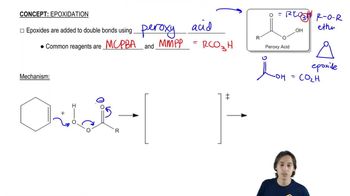
    The functional group formed is an epoxide, which is a cyclic three-membered ether.
  • What is the general formula for a peroxy acid used in epoxidation?

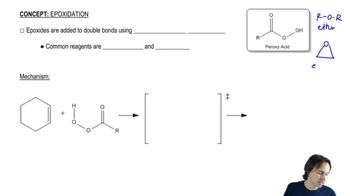
    The general formula is RCO3H, similar to a carboxylic acid but with an extra oxygen.
  • Name two common peroxy acids used in epoxidation reactions.

    MCPBA and MMPP are two common peroxy acids used.
  • What does the double bond attack in the mechanism of epoxidation?

    The double bond attacks the terminal oxygen of the peroxy acid.
  • What are the products of the epoxidation reaction with a peroxy acid?

    The products are an epoxide and a carboxylic acid.
  • How many arrows are involved in the detailed mechanism of epoxidation?

    There are five arrows in total, representing electron shifts and bond formations.
  • What is unique about the transition state in the epoxidation mechanism?

    The transition state features partial bonds at every site where bonds are being made or broken.
  • Is it common for professors to require drawing the epoxidation transition state?

    No, most professors do not require it, but some may.
  • What is the alternative method to synthesize epoxides besides peroxy acids?

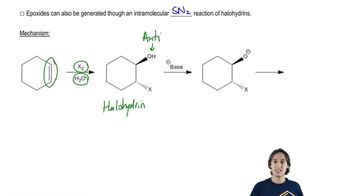
    Epoxides can also be synthesized from halohydrins via an intramolecular SN2 reaction.
  • How is a halohydrin formed from a double bond?

    A halohydrin is formed by exposing a double bond to diatomic halogen and water.
  • What role does a base play in the halohydrin method for epoxide synthesis?

    The base deprotonates the alcohol, creating a nucleophile for the intramolecular SN2 reaction.
  • What happens during the intramolecular SN2 reaction in the halohydrin method?

    The nucleophilic oxygen attacks the carbon with the leaving group, forming the epoxide ring.
  • What is the stereochemistry of halohydrin formation from a double bond?

    The stereochemistry is anti, meaning the substituents are added to opposite sides.
  • What is the leaving group in the halohydrin method for epoxide formation?

    The leaving group is the halogen (X), which is expelled as X⁻.
  • Why is it important to know both epoxidation methods for exams?

    Both methods are commonly taught and tested, so students should be familiar with each.