Back

Epoxide Reactions definitions

Control buttons has been changed to "navigation" mode.
1/15
  • Epoxide

    A highly strained, three-membered cyclic ether with significant ring tension, making it much more reactive than typical ethers.
  • Ether

    A functional group featuring an oxygen atom bonded to two alkyl or aryl groups, generally unreactive under standard conditions.
  • Ring Strain

    The increased potential energy in a small cyclic molecule due to bond angle distortion and torsional strain, driving reactivity.
  • Acid Catalysis

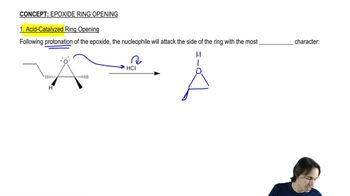
    A process where an acid donates a proton to activate a molecule, making it more susceptible to nucleophilic attack.
  • Base Catalysis

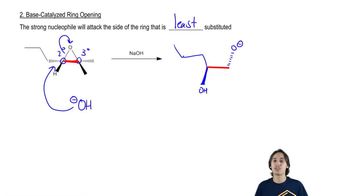
    A process where a base directly attacks a substrate, often favoring less hindered positions without prior protonation.
  • Protonation

    The addition of a hydrogen ion to an atom, increasing its positive character and altering its reactivity.
  • Nucleophile

    A species with electron-rich sites that seeks out and forms bonds with electron-deficient atoms or centers.
  • Substitution Pattern

    The classification of carbon atoms in a molecule based on the number of attached alkyl groups, influencing reaction outcomes.
  • Vicinal Diol

    A compound featuring two hydroxyl groups attached to adjacent carbon atoms, often formed via epoxide ring opening.
  • Anti Addition

    A stereochemical outcome where substituents add to opposite faces of a ring or double bond, resulting in trans products.
  • Dihydroxylation

    A transformation introducing two hydroxyl groups onto a molecule, typically on neighboring carbons.
  • Carbocation Character

    A partial positive charge developed on a carbon atom during a reaction, influencing nucleophilic attack sites.
  • Product Distribution

    The arrangement of functional groups in the final molecules, determined by the mechanism and reaction conditions.
  • Syn Addition

    A process where two substituents add to the same face of a molecule, yielding cis products, contrasted with anti addition.
  • Three-Membered Ring

    A cyclic structure with three atoms, notable for its high angle strain and tendency to undergo ring-opening reactions.