Back

Epoxide Reactions quiz

Control buttons has been changed to "navigation" mode.
1/15
  • Why are epoxides more reactive than ethers?

    Epoxides are more reactive because their three-membered ring structure is highly strained, making them eager to undergo ring-opening reactions.
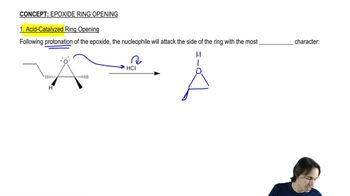
  • What is the first step in an acid-catalyzed epoxide ring opening?

    The first step is protonation of the epoxide oxygen by the acid.
  • In acid-catalyzed ring opening, which carbon does the nucleophile attack?

    The nucleophile attacks the more substituted carbon of the epoxide ring.
  • What is the product arrangement in acid-catalyzed epoxide opening?

    The nucleophile ends up on the more substituted carbon, and an alcohol forms on the least substituted carbon.
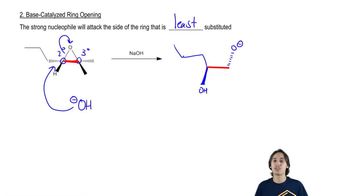
  • What is the first step in a base-catalyzed epoxide ring opening?

    There is no protonation step; the nucleophile directly attacks the epoxide.
  • In base-catalyzed ring opening, which carbon does the nucleophile attack?

    The nucleophile attacks the least substituted carbon of the epoxide ring.
  • What is the typical product of base-catalyzed epoxide opening with NaOH?

    The typical product is an anti vicinal diol, where two alcohols are added to adjacent carbons in a trans (anti) fashion.
  • What does 'vicinal diol' mean in the context of epoxide reactions?

    A vicinal diol means two alcohol groups are added to adjacent carbons.
  • Why do both acid- and base-catalyzed epoxide openings give anti products?

    Because opening the three-membered ring forces the substituents to end up on opposite sides (anti) due to ring strain.
  • How can you distinguish between anti and syn vicinal diols?

    Anti vicinal diols have alcohols on opposite sides (trans), while syn vicinal diols have them on the same side (cis); the mechanism determines which forms.
  • What is unique about using NaOH in base-catalyzed epoxide opening?

    Using NaOH specifically leads to anti vicinal diols, which is important for distinguishing from syn diol formation.
  • What happens to the O- formed in base-catalyzed epoxide opening?

    The O- is typically protonated in a subsequent step, often by water, to form an alcohol.
  • What determines the regioselectivity in acid-catalyzed epoxide opening?

    Regioselectivity is determined by the nucleophile attacking the carbon that can best stabilize positive charge, usually the more substituted carbon.
  • What determines the regioselectivity in base-catalyzed epoxide opening?

    The nucleophile attacks the least substituted carbon because it is less hindered and more accessible.
  • What is the key difference between acid- and base-catalyzed epoxide ring opening?

    Acid-catalyzed opening favors attack at the more substituted carbon after protonation, while base-catalyzed opening favors attack at the least substituted carbon without protonation.