Back

Equatorial Preference definitions

Control buttons has been changed to "navigation" mode.
1/14
  • Equatorial Position

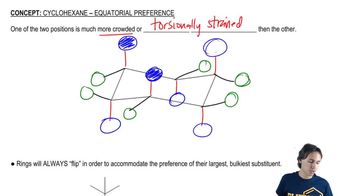
    A location on a cyclohexane ring that offers more space, reducing crowding and strain for attached groups.
  • Axial Position

    A spot on a cyclohexane ring oriented straight up or down, leading to increased crowding and strain.
  • Torsional Strain

    Destabilization caused by atoms or groups being forced too close together, increasing repulsion.
  • Steric Hindrance

    Physical crowding of atoms or groups that limits their spatial arrangement and stability.
  • Chair Conformation

    A three-dimensional shape of cyclohexane that minimizes strain by alternating up and down carbon atoms.
  • Ring Flip

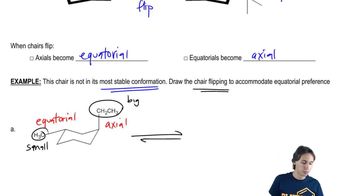
    A process where a cyclohexane chair inverts, swapping axial and equatorial positions for all substituents.
  • Substituent

    An atom or group attached to a cyclohexane ring, whose size influences its preferred position.
  • tert-Butyl Group

    A bulky substituent that overwhelmingly favors the equatorial position due to its large size.
  • Hydrogen Atom

    A small group whose presence in axial positions can still contribute to crowding and strain.
  • Cyclohexane

    A six-membered carbon ring that adopts chair conformations to minimize strain.
  • Stability

    A measure of how energetically favorable a molecular arrangement is, often increased by minimizing strain.
  • Crowding

    A situation where atoms or groups are forced into close proximity, leading to increased repulsion.
  • Equator

    A reference to the more spacious, spread-out positions around the middle of a cyclohexane ring.
  • North Pole

    A metaphor for the axial positions, highlighting their crowded, less favorable nature.