Back

Equatorial Preference quiz

Control buttons has been changed to "navigation" mode.
1/15
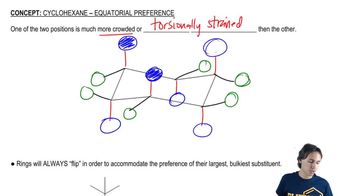
  • What is the main reason equatorial positions are more stable than axial positions in cyclohexane chairs?

    Equatorial positions are less crowded and experience less torsional strain than axial positions.
  • How do axial positions differ from equatorial positions in terms of orientation?

    Axial positions are oriented straight up and down, while equatorial positions are angled slightly outward from the ring.
  • Why do bulky groups prefer the equatorial position in a chair conformation?

    Bulky groups prefer the equatorial position to minimize steric hindrance and avoid crowding with other atoms.
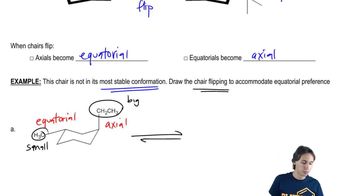
  • What happens to the positions of substituents when a chair conformation flips?

    When a chair flips, axial substituents become equatorial and equatorial substituents become axial.
  • What percentage of tert-butylcyclohexane exists with the tert-butyl group in the equatorial position?

    Over 99% of tert-butylcyclohexane has the tert-butyl group in the equatorial position.
  • What causes increased torsional strain in the axial position?

    Increased torsional strain in the axial position is caused by close proximity and crowding with hydrogen atoms.
  • How does the analogy of the equator help explain equatorial positions?

    Equatorial positions are compared to the equator of the earth, where there is more space and less crowding.
  • What is the effect of placing a large group in the axial position?

    Placing a large group in the axial position increases crowding and torsional strain, making it less stable.
  • What happens to the stability of a cyclohexane ring when a bulky group is in the equatorial position?

    The stability of the ring increases when a bulky group is in the equatorial position.
  • Why do axial positions 'suck' for large substituents, according to the lesson?

    Axial positions are crowded and uncomfortable for large substituents due to steric interactions with nearby hydrogens.
  • What is the relationship between ring flipping and substituent preference?

    Ring flipping allows substituents to move between axial and equatorial positions, favoring the more stable equatorial position for bulky groups.
  • How are the axial positions described in terms of their location on the cyclohexane ring?

    Axial positions are described as being at the 'north pole' and 'south pole' of the ring.
  • What is the main factor that determines which chair conformation is favored?

    The main factor is the placement of the largest substituent in the equatorial position to minimize strain.
  • What happens to the shape of the chair when it flips?

    The shape of the chair changes, and all axial positions become equatorial and vice versa.
  • Why is less than 1% of tert-butylcyclohexane found with the tert-butyl group in the axial position?

    Because the axial position is much more torsionally strained and crowded, making it highly unfavorable for bulky groups like tert-butyl.