Skip to main content
Organic Chemistry
My Course
Learn
Exam Prep
AI Tutor
Study Guides
Textbook Solutions
Flashcards
Explore
Try the app
My Course
Learn
Exam Prep
AI Tutor
Study Guides
Textbook Solutions
Flashcards
Explore
Try the app
Back
Equilibrium Constant definitions
You can tap to flip the card.
Equilibrium Constant
You can tap to flip the card.
👆
Equilibrium Constant
A ratio expressing how much a reaction favors products over reactants at equilibrium, crucial for understanding acid dissociation.
Track progress
Control buttons has been changed to "navigation" mode.
1/14
Related flashcards
Related practice
Recommended videos
Equilibrium Constant quiz
Equilibrium Constant and pKa
10 Terms
Equilibrium Constant
3. Acids and Bases
7 problems
Topic
Johnny
pKa
3. Acids and Bases
6 problems
Topic
Johnny
3. Acids and Bases - Part 1 of 2
4 topics
10 problems
Chapter
Laura
3. Acids and Bases - Part 2 of 2
3 topics
9 problems
Chapter
Johnny
02:15
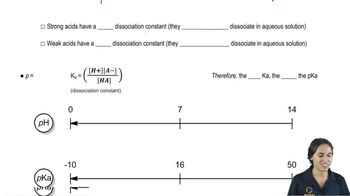
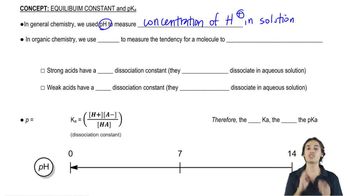
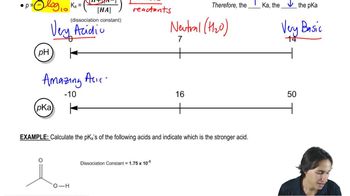
The pH scale vs. the pKa scale.
4259
views
32
rank
4
comments
02:19
The relationship between equilibrium constant and pKa.
4054
views
23
rank
01:46
Why we use pKa instead of pH.
4295
views
32
rank
2
comments
Terms in this set (14)
Hide definitions
Equilibrium Constant
A ratio expressing how much a reaction favors products over reactants at equilibrium, crucial for understanding acid dissociation.
pKa
A scale derived from the negative log of the dissociation constant, indicating a molecule's tendency to donate protons.
Dissociation Constant
A value showing how likely a molecule is to break apart into ions, directly related to acid strength.
Strong Acid
A substance with a high dissociation constant, fully releasing protons in solution and possessing a low pKa.
Weak Acid
A substance with a low dissociation constant, only partially releasing protons in solution and having a high pKa.
pH
A measure of hydronium ion concentration in solution, indicating how acidic or basic a solution is.
Hydronium Ion
A positively charged species formed when a proton associates with water, central to acidity measurements.
Aqueous Solution
A medium where water is the solvent, commonly used for observing acid dissociation behavior.
Negative Logarithm
A mathematical operation applied to the dissociation constant to yield pKa, inverting the scale for acid strength.
Acid Strength
A property reflecting how readily a molecule donates protons, closely linked to low pKa values.
Neutral Point
A reference value on the pKa scale, typically around 16, representing water and dividing strong and weak acids.
Product
A species formed after acid dissociation, such as protons, used in calculating the equilibrium constant.
Reactant
A starting molecule before dissociation, compared to products to determine the equilibrium constant.
pKa Scale
A range from about -10 to 50, used to compare the acidic tendencies of different molecules.
 BackBack

 02:15
02:15