Back

Ether Cleavage definitions

Control buttons has been changed to "navigation" mode.
1/15
  • Ether

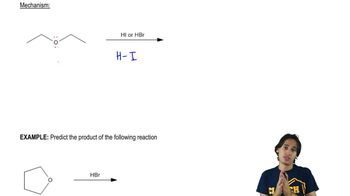
    A highly stable, unreactive compound with an oxygen atom bonded to two alkyl or aryl groups, similar in stability to alkanes.
  • Cleavage

    A process where a strong acid splits a molecule into two parts, often producing alkyl halides and alcohols from ethers.
  • Strong Acid

    A substance like HI or HBr capable of protonating ethers, initiating their otherwise difficult bond-breaking reactions.
  • Protonation

    Addition of a hydrogen ion to a molecule, increasing its reactivity and enabling further chemical transformation.
  • Nucleophile

    A species with a strong tendency to donate electrons, such as I⁻, which attacks electron-deficient centers in reactions.
  • Backside Attack

    A mechanism where a nucleophile approaches from the side opposite the leaving group, characteristic of SN2 reactions.
  • Alkyl Halide

    A compound formed when an alkyl group is bonded to a halogen, often produced during ether cleavage.
  • Alcohol

    A molecule containing a hydroxyl group, generated as an intermediate or product during ether cleavage.
  • Leaving Group

    An atom or group that departs with a pair of electrons during a substitution or elimination reaction, facilitating bond breaking.
  • SN2 Mechanism

    A one-step substitution process where a nucleophile attacks and a leaving group departs simultaneously, leading to inversion of configuration.
  • Cyclic Ether

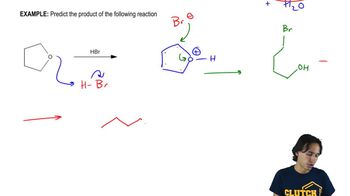
    A ring-shaped molecule containing an oxygen atom, which can undergo acid-catalyzed cleavage similar to linear ethers.
  • Epoxide

    A three-membered cyclic ether, distinct from larger cyclic ethers, with unique reactivity due to ring strain.
  • Heterolytic Cleavage

    Bond breaking where both electrons go to one atom, generating ions, and requiring strong acids in the case of ethers.
  • Alkane

    A saturated hydrocarbon, referenced for its similar unreactivity and stability compared to ethers.
  • Halide Ion

    A negatively charged halogen species, such as I⁻ or Br⁻, acting as a nucleophile in ether cleavage.