Back

Formal Charges definitions

Control buttons has been changed to "navigation" mode.
1/13
  • Formal Charge

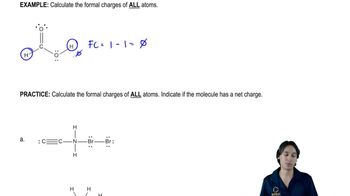
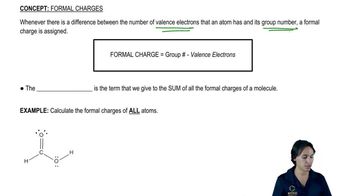
    A value found by subtracting the sum of bonds and lone pairs from the group number for an atom in a molecule.
  • Bonding Preference

    The typical number of bonds and lone pairs an atom seeks to achieve a stable electron configuration.
  • Valence Electrons

    Electrons in the outermost shell of an atom, represented by sticks and dots in Lewis structures.
  • Group Number

    A value from the periodic table indicating how many valence electrons an atom ideally wants.
  • Sticks

    Lines in a Lewis structure representing shared electron pairs, or bonds, between atoms.
  • Dots

    Pairs of electrons not involved in bonding, shown as lone pairs in Lewis structures.
  • Net Charge

    The overall charge of a molecule, calculated by summing all individual formal charges.
  • Lone Pair

    A pair of valence electrons not shared with another atom, depicted as dots in diagrams.
  • Lewis Structure

    A diagram showing the arrangement of bonds and lone pairs around atoms in a molecule.
  • Double Bond

    A connection between two atoms involving two shared pairs of electrons, often seen with oxygen.
  • Hydrogen

    An element with one valence electron, typically forming one bond and having a formal charge of zero.
  • Oxygen

    An element with six valence electrons, usually forming two bonds and two lone pairs for stability.
  • Carbon

    An element with four valence electrons, generally forming four bonds to satisfy its bonding preference.