Back

Halohydrin quiz

Control buttons has been changed to "navigation" mode.
1/15
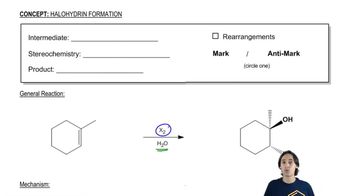
  • What is the main difference between halogenation and halohydrin formation reactions?

    Halohydrin formation involves adding a halogen and water across a double bond, resulting in an alcohol and a halogen, whereas halogenation adds only halogens.
  • What functional groups are present in the product of a halohydrin formation reaction?

    The product contains an alcohol group on one side and a halogen on the other side of the former double bond.
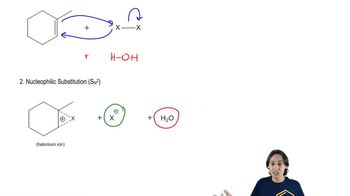
  • What intermediate is formed during the halohydrin formation mechanism?

    A bridged halonium ion intermediate is formed during the reaction.
  • What is the stereochemistry of the halohydrin product?

    The product has anti stereochemistry due to the opening of the three-membered halonium ring.
  • Are carbocation rearrangements possible in halohydrin formation?

    No, rearrangements do not occur because there is no carbocation intermediate.
  • Which carbon does water attack during halohydrin formation, and why?

    Water attacks the more substituted carbon because it has greater positive character, following Markovnikov's rule.
  • Why does water act as the nucleophile instead of the halide ion in halohydrin formation?

    Although the halide ion is a stronger nucleophile, water is present in much greater excess and thus attacks more frequently.
  • What role does the halide ion play in the final step of halohydrin formation?

    The halide ion acts as a base to deprotonate the alcohol, completing the reaction.
  • What is the regiochemistry of halohydrin formation?

    The reaction follows Markovnikov regiochemistry, with the alcohol group attaching to the more substituted carbon.
  • Can halohydrin formation produce a racemic mixture, and why?

    Yes, because water can attack either side of the planar halonium ion, leading to both enantiomers.
  • What is the major product when a double bond reacts with a diatomic halogen in water?

    The major product is a halohydrin, with an alcohol and a halogen added across the double bond.
  • Why is the halonium ion considered unstable in halohydrin formation?

    The halonium ion is highly reactive and will react quickly with any available nucleophile, such as water.
  • What happens if there is a large excess of water compared to halide ions in the reaction mixture?

    Water will be the primary nucleophile attacking the halonium ion, leading to halohydrin formation.
  • What determines whether the alcohol or halogen attaches to the more substituted carbon in halohydrin formation?

    The nucleophile (water) attaches to the more substituted carbon due to its higher positive character, following Markovnikov's rule.
  • How does the presence of water change the outcome compared to halogenation alone?

    Water's presence leads to the formation of a halohydrin instead of a dihalide, as water attacks the halonium ion instead of the halide ion.