Back

Introduction to Polymers definitions

Control buttons has been changed to "navigation" mode.
1/14
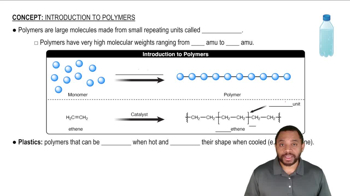
  • Polymer

    A large molecule composed of many repeating units, resulting in high molecular weight and diverse material properties.
  • Monomer

    A small, simple molecule that serves as a building block, linking together to form larger molecular chains.
  • Polymerization

    A process that connects small molecular units into long chains, dramatically increasing molecular size.
  • Molecular Weight

    A measure of the mass of a molecule, often extremely high for substances made of many repeating units.
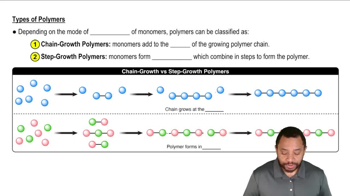
  • Chain Growth Polymer

    A material formed by sequentially adding identical units to the ends of a growing molecular chain.
  • Step Growth Polymer

    A material produced by combining fragments of varying sizes in stages, often involving different types of units.
  • Plastic

    A moldable material that softens with heat and retains its shape upon cooling, commonly used in daily life.
  • Ethene

    A simple organic molecule with a double bond, serving as a common starting unit for certain synthetic materials.
  • Polyethylene

    A substance made by linking many ethene units, widely used in items like bottles due to its flexibility and durability.
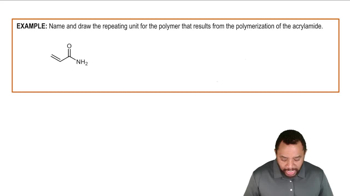
  • Repeating Unit

    A structural segment that appears multiple times within a large molecular chain, defining its composition.
  • Dimer

    A molecular fragment formed by the combination of two identical or different small units.
  • Trimer

    A molecular fragment resulting from the linkage of three small units, which can further combine in larger structures.
  • Tetramer

    A molecular fragment consisting of four linked small units, often seen as an intermediate in material formation.
  • Catalyst

    A substance that accelerates the connection of small units into long chains without being consumed in the process.