Organic Chemistry
My Course
Learn
Exam Prep
AI Tutor
Study Guides
Textbook Solutions
Flashcards
Explore
Try the app
My Course
Learn
Exam Prep
AI Tutor
Study Guides
Textbook Solutions
Flashcards
Explore
Try the app
Back
Isoelectric Point quiz
You can tap to flip the card.
What is the isoelectric point (pI) of an amino acid?
You can tap to flip the card.
👆
What is the isoelectric point (pI) of an amino acid?
The isoelectric point is the pH at which an amino acid has zero net charge, meaning the greatest concentration of zwitterions is present.
Track progress
Control buttons has been changed to "navigation" mode.
1/15
Related flashcards
Related practice
Recommended videos
Isoelectric Point definitions
Isoelectric Point
15 Terms
Isoelectric Point
29. Amino Acids
6 problems
Topic

Johnny
26. Amino Acids, Peptides, and Proteins
5 topics
13 problems
Chapter
Johnny
Guided course
02:28
Isoelectric Point of Charged Amino Acids
1405
views
7
rank
1
comments
Guided course
03:17
Isoelectric Point of Non-Charged Amino Acids
1360
views
9
rank
Guided course
01:49
Isoelectric Point of Cysteine
2672
views
4
rank
Terms in this set (15)
Hide definitions
What is the isoelectric point (pI) of an amino acid?
The isoelectric point is the pH at which an amino acid has zero net charge, meaning the greatest concentration of zwitterions is present.
How is the isoelectric point (pI) of a generic amino acid calculated?
It is calculated by averaging the pKa values of the carboxyl group (about 2) and the ammonium group (about 9).
What is the approximate pI value for most generic amino acids?
The approximate pI value is 5.5 for most generic amino acids.
Why do zwitterions have a net charge of zero?
Zwitterions have both a positive and a negative charge that cancel each other out, resulting in a net charge of zero.
Into how many groups are amino acids categorized for pI calculation, and what are they?
Amino acids are categorized into three groups: non-acidic/basic, acidic/basic, and cysteine.
How is the pI calculated for non-acidic/basic amino acids?
For non-acidic/basic amino acids, the pI is calculated by averaging the pKa values of the carboxyl and ammonium groups.
Which amino acids require a different method for pI calculation due to their side chains?
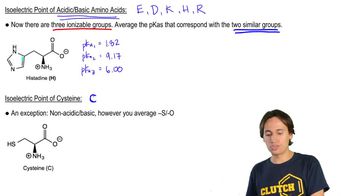
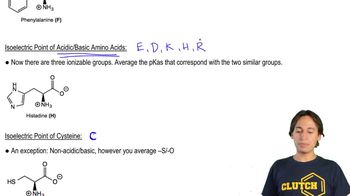
Amino acids with acidic or basic side chains, such as histidine, require a different method for pI calculation.
How do you choose which pKa values to average for amino acids with acidic or basic side chains?
You average the pKa values of the two most similar ionizable groups, usually the side chain and either the carboxyl or ammonium group.
For histidine, which two pKa values are averaged to calculate its pI?
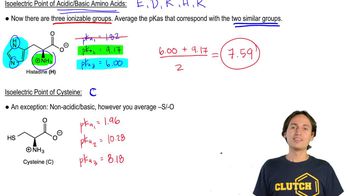
For histidine, the pKa values of the side chain (6.00) and the ammonium group (9.17) are averaged.
What is the calculated isoelectric point (pI) of phenylalanine?
The isoelectric point of phenylalanine is 5.48, calculated by averaging its carboxyl and ammonium pKa values.
Why is cysteine treated as a special case in pI calculations?
Cysteine is unique because its ionizable side chain contains sulfur, which is treated as similar to oxygen for pI calculations.
Which pKa values are used to calculate the pI of cysteine?
For cysteine, the pKa values of the carboxyl group and the sulfur-containing side chain are averaged.
What is the calculated isoelectric point (pI) of histidine?
The isoelectric point of histidine is 7.59, calculated by averaging the pKa values of its side chain and ammonium group.
What is the calculated isoelectric point (pI) of cysteine?
The isoelectric point of cysteine is 5.07, calculated by averaging the pKa values of the carboxyl group and the sulfur side chain.
How many of the 20 amino acids have their pI calculated by simply averaging the carboxyl and ammonium pKa values?
Fourteen out of the twenty amino acids use this straightforward averaging method for pI calculation.