IUPAC Naming quiz #3 Flashcards

IUPAC Naming quiz #3
Control buttons has been changed to "navigation" mode.
1/40
  • How do you determine the parent chain when naming an alkane according to IUPAC rules?
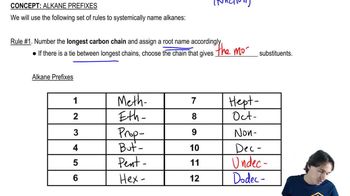
    The parent chain is the longest continuous chain of carbon atoms. If there is a tie, choose the chain that results in the greatest number of substituents.
  • How are substituents named in IUPAC nomenclature?
    Substituents are named by replacing the -ane ending of the corresponding alkane with -yl (e.g., methane becomes methyl, ethane becomes ethyl).
  • What is the rule for numbering when two substituents are equidistant from both ends of the parent chain?
    If substituents are equidistant from both ends, number the chain so that the next substituent gets the lowest possible number. If still tied, use alphabetical order.
  • When listing substituents in an IUPAC name, how is alphabetical order determined?
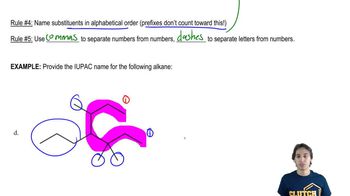
    List substituents in alphabetical order, ignoring any multiplicative prefixes (di-, tri-, etc.) when determining order.
  • What is the IUPAC prefix for a one-carbon parent chain?
    The prefix for a one-carbon chain is 'meth-'.
  • What is the IUPAC prefix for a three-carbon parent chain?
    The prefix for a three-carbon chain is 'prop-'.
  • What is the IUPAC prefix for a five-carbon parent chain?
    The prefix for a five-carbon chain is 'pent-'.
  • What is the IUPAC prefix for a seven-carbon parent chain?
    The prefix for a seven-carbon chain is 'hept-'.
  • What is the IUPAC prefix for a nine-carbon parent chain?
    The prefix for a nine-carbon chain is 'non-'.
  • What is the IUPAC prefix for an eleven-carbon parent chain?
    The prefix for an eleven-carbon chain is 'undec-'.
  • How do you name a molecule with multiple different substituents?
    List all substituents in alphabetical order, assign each a locant (number), and use appropriate prefixes for identical groups. Combine the substituent names with the parent chain name.
  • How do you name a compound with an ethyl group as a substituent?
    Identify the position of the ethyl group on the parent chain, assign the lowest possible number, and include 'ethyl' in the name at the appropriate position.
  • How do you name a compound with two methyl groups on the parent chain?
    Assign locants to each methyl group, use the prefix 'di-' (e.g., dimethyl), and include the locants in the name (e.g., 2,3-dimethylpentane).
  • What is the correct way to write numbers and letters in an IUPAC name?
    Use commas to separate numbers and hyphens to separate numbers from letters, with no spaces in the name.
  • What is the IUPAC name for a straight-chain alkane with five carbons?
    The IUPAC name is pentane.
  • How do you name a compound with a halogen substituent according to IUPAC rules?
    Name the halogen as a substituent (e.g., fluoro, chloro, bromo, iodo), assign its locant, and list it in alphabetical order with other substituents.
  • How do you name a compound with a functional group such as an alcohol?
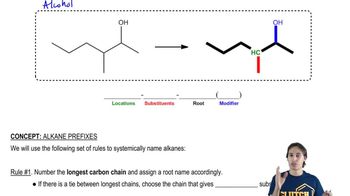
    Identify the parent chain containing the functional group, number the chain to give the functional group the lowest possible number, and use the appropriate suffix (e.g., -ol for alcohols).
  • How do you name a branched alkane with a three-carbon branch?
    A three-carbon branch is called a propyl group. Assign its locant and include 'propyl' in the name at the appropriate position.
  • How do you name a compound with a one-carbon branch?
    A one-carbon branch is called a methyl group. Assign its locant and include 'methyl' in the name at the appropriate position.
  • How do you name a compound with a five-carbon branch?
    A five-carbon branch is called a pentyl group. Assign its locant and include 'pentyl' in the name at the appropriate position.
  • How do you name a compound with a cycloalkane structure?
    Name the ring as the parent chain (e.g., cyclohexane), assign locants to substituents to give the lowest possible numbers, and list substituents in alphabetical order.
  • How do you name a compound with both a double bond and a substituent?
    Number the chain to give the double bond the lowest possible number, assign locants to substituents, and assemble the name with the appropriate suffix and substituent names.
  • How do you name a compound with a functional group as the highest priority?
    Number the chain to give the functional group the lowest possible number, use the appropriate suffix, and name other groups as substituents.
  • How do you name a compound with a branched substituent?
    Name the substituent as a substituted alkyl group, using parentheses if necessary, and assign its locant on the parent chain.
  • How do you name a compound with an isopropyl group?
    Name the group as isopropyl, assign its locant, and include it in the name in alphabetical order.
  • How do you name a compound with a sec-butyl group?
    Name the group as sec-butyl, assign its locant, and include it in the name in alphabetical order (ignoring 'sec-' for alphabetization).
  • How do you name a compound with a phenyl group?
    Name the group as phenyl, assign its locant, and include it in the name in alphabetical order.
  • How do you name a compound with a nitro group?
    Name the group as nitro, assign its locant, and include it in the name in alphabetical order.
  • How do you name a compound with a carboxylic acid group?
    Name the parent chain as a carboxylic acid (using the suffix -oic acid), number the chain to give the carboxyl group position 1, and name other groups as substituents.
  • How do you name a compound with an amine group?
    Name the parent chain with the suffix -amine, number the chain to give the amine the lowest possible number, and name other groups as substituents.
  • How do you name a compound with a ketone group?
    Name the parent chain with the suffix -one, number the chain to give the ketone the lowest possible number, and name other groups as substituents.
  • How do you name a compound with a sulfonic acid group?
    Name the parent chain with the suffix -sulfonic acid, number the chain to give the sulfonic acid group the lowest possible number, and name other groups as substituents.
  • How do you name a compound with a bromo substituent?
    Name the group as bromo, assign its locant, and include it in the name in alphabetical order.
  • How do you name a compound with an iodo substituent?
    Name the group as iodo, assign its locant, and include it in the name in alphabetical order.
  • How do you name a compound with multiple halogen substituents?
    Assign locants to each halogen, use appropriate prefixes (di-, tri-, etc.), and list them in alphabetical order with other substituents.
  • How do you name a compound with a 3-methylbutyl substituent?
    Assign the locant for the 3-methylbutyl group, name it as such, and include it in the name in alphabetical order.
  • How do you name a compound with a 4-bromo-2-chlorophenol structure?
    Assign locants to the bromo and chloro substituents on the phenol ring, list them in alphabetical order, and use the parent name phenol.
  • How do you name a compound with a (CH3)3CCH2CH(CH2CH3)2 structure?
    Identify the parent chain, assign locants to each substituent, name the branches (e.g., tert-butyl, ethyl), and assemble the name according to IUPAC rules.
  • How do you name a compound with a straight-chain alkyl iodide such as CH3CH2CH2CH2CH2I?
    The compound is named as 1-iodopentane, with the iodine substituent at position 1 on a five-carbon chain.
  • How do you name a compound with a condensed formula such as CH3CH(CH3)CH2CH3?
    Identify the parent chain, assign locants to the substituents, and assemble the name according to IUPAC rules (e.g., 2-methylbutane).